
Restaurant Growth
Should Restaurants Use AI-Generated Food Photos? What Owners Need to Consider
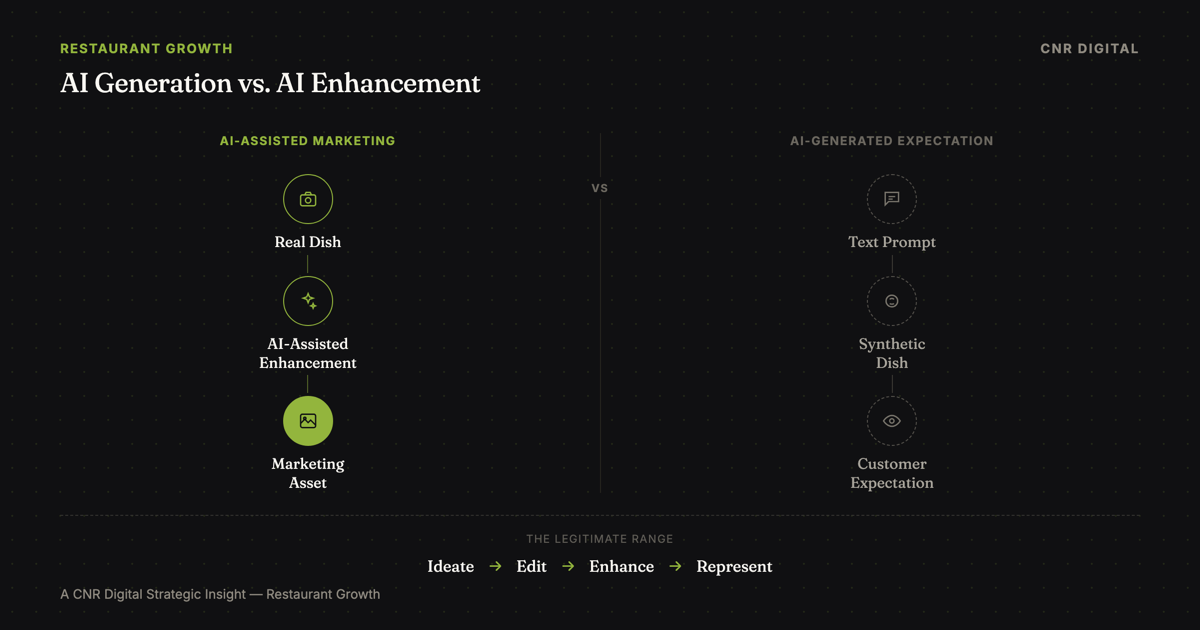
Should restaurants use AI-generated food photos? Generally, no, not for images meant to represent an actual menu item a customer will order. AI-generated food images create a real risk that what's marketed and what's served will diverge, and that gap is where customer trust breaks.
AI-assisted photography is a different story. Using AI to clean up lighting, sharpen a background or edit a real photo of the real dish is a legitimate, increasingly common part of restaurant marketing.
The distinction that matters isn't "AI good" or "AI bad." It's this:
AI Generation ≠ AI Enhancement
One starts with the real product. The other may manufacture the product representation.
Why Are Restaurants Using AI-Generated Food Photos?
Professional food photography is expensive, and a lot of restaurants, especially new ones, open without a photography budget at all. AI image tools promise a fast, cheap way to fill a menu, a website or a delivery-app listing with something that looks polished.
For restaurants without any usable photos yet, that's a genuinely appealing shortcut. The problem isn't the impulse. It's what happens when the shortcut produces an image of food that was never actually cooked or plated, and a customer orders expecting to receive it.
Not All AI Food Photography Is the Same
"AI food photography" gets used as one term for at least five different things, and they carry very different levels of risk.
The Legitimate Range of AI-Assisted Food Photography
Using AI to Ideate a Photoshoot
Using AI to plan a shoot (generating mood boards, plating ideas or lighting references before a real photographer or the owner picks up a camera) never touches the actual marketing asset. This is planning, not representation, and it carries essentially no trust risk.
Editing Authentic Photography
Cropping, color-correcting or straightening a real photo of the real dish is standard photo editing. AI-assisted versions of these tools (smarter auto-crop, noise reduction, background cleanup) are a faster version of something photographers have always done.
AI-Enhancing a Real Food Photo
This is where AI tools built specifically for restaurants operate: taking an actual photo of the actual dish and improving lighting, background, sharpness or composition, while leaving the food itself recognizable as what it is. The real photo is still the foundation.
Creating Decorative or Conceptual Imagery
AI-generated imagery used for genuinely decorative purposes (an abstract background pattern, a stylized graphic for a social post that isn't presented as a photo of a specific dish) carries low risk because no reasonable customer would mistake it for a product photo.
Generating a Fictional Representation of a Real Menu Item
This is the highest-risk category: a fully AI-generated image, built from a text prompt, presented as if it shows an actual dish on the menu. Nothing about it started with the real food. This is where "AI-assisted marketing" becomes "AI-generated product expectation."
The Trust Problem Isn't "AI." It's Expectation Mismatch.
Marketing Expectation ↓ Physical Experience
When those diverge, trust becomes the business risk.
Restaurant marketing has always involved some presentation: better lighting than a home kitchen, a styled plate, a flattering angle. What's different about a fully AI-generated dish image is that it isn't a flattering version of something real. It's a picture of something that doesn't exist.
A recently opened San Francisco café, Grind & Unwind, experienced this directly. After opening on Haight Street in May 2026, the café displayed AI-generated images of sandwiches, coffees and pastries in its window. Customers noticed the telltale flaws immediately (oddly textured bread, plastic-looking pastries), and the backlash escalated to graffiti on the storefront. The owners removed the AI-generated images and replaced them.
The lesson isn't that customers universally hate AI. It's that a synthetic image standing in for a real menu item is a specific, identifiable category of marketing risk, and once customers notice the mismatch, it becomes a story about the restaurant, not just the photo.
The question worth asking before publishing any AI-touched image is simple: would a reasonable customer believe this represents what they'll actually receive?
What Do Restaurant Platforms Say About AI Food Images?
Restaurants don't only answer to their own judgment here. The platforms where those images actually appear have their own policies, and they're moving in a consistent direction: enhancement of real photos is welcome, fabrication of unreal ones is not.
Google Business Profile
Google's Business Profile photo guidelines state that photos "should be in focus, well lit, and have no significant alterations or excessive use of filters or AI". In Google's words, the image should represent reality. That's a direct, sourced statement from Google about photo authenticity, not a ranking-factor claim. Google has not published a statement tying AI-generated photos to search or Maps ranking, and this article makes no such claim.
DoorDash
DoorDash's approach is built around enhancing real photos, not generating fictional ones. DoorDash AI Photo Enhance offers merchants three modes: cleaning up backgrounds and lighting while keeping the original dish untouched, restaging the food on different dinnerware, and matching the style of a reference photo. In every mode, the tool starts from a real photo of the merchant's actual food, and enhanced photos still go through DoorDash's standard photo moderation and review before they go live. For general photo requirements (composition, resolution, avoiding upscaled or unclear images), see DoorDash's menu photo guidance.
Uber Eats
Uber has introduced its own AI photo tooling for merchants, aimed at the same enhancement category rather than generation. In Uber's own announcement, the company describes using AI to detect and enhance low-quality food images, improving lighting, resolution, framing and plating, to help restaurants showcase their dishes more accurately. The stated goal is accuracy, not invention: improving how a real dish is presented, not replacing it with one that doesn't exist.
Across all three platforms, the pattern is consistent: AI tools built for restaurants are designed to make real food look better, not to manufacture food that isn't there.
Should Restaurants Disclose That an Image Is AI-Generated?
This is genuinely jurisdiction-dependent, and this section is marketing strategy, not legal advice.
In the European Union, the European Commission's transparency guidance under Article 50 of the AI Act requires that AI-generated or manipulated image content be marked or disclosed, with the strictest obligations applying to content that could be mistaken for authentic reality. Providers of AI systems must ensure synthetic outputs carry machine-readable markings, and deployers face disclosure obligations for content that risks being mistaken for something real.
Whether and how that applies to a specific restaurant's marketing image depends on jurisdiction, how the image is used and who's deploying it, questions worth directing to qualified counsel if a restaurant operates internationally or is uncertain about its obligations. In the U.S., there's no equivalent federal requirement as of publication, though that can change quickly.
The more useful business standard doesn't wait for a legal mandate: if an image could reasonably be mistaken for a photo of the actual dish, disclosure (or simply not using a synthetic image in that context) protects the restaurant's credibility regardless of what any specific law requires.
Authentic Restaurant Photography Does More Than Fill the Menu
Real photography of the real restaurant does work that a synthetic image structurally can't. It shows customers what they're actually deciding to order. It supports local SEO for New Jersey small businesses and Google Business Profile credibility, since Google's own guidance ties photo authenticity to representing reality. And it becomes reusable across the digital foundation for a new restaurant: the website, delivery platforms, social channels and press outreach can all draw from the same real, accurate photo library instead of maintaining a separate synthetic one.
Does Authentic Photography Help With AI Search?
There's no confirmed ranking factor connecting photo authenticity to how AI search tools recommend restaurants, and this article isn't claiming one. What's defensible is more modest: authentic photography expands the accurate digital evidence available about a restaurant, which helps real customers evaluate it, independent of any unproven AI-search effect. More accurate information about a restaurant is useful on its own terms, the same way it is for AI restaurant discovery through Google Maps more broadly.
What About Instagram? Can AI Images Work There?
Social platforms tolerate more stylization than a menu or an ordering app: an obviously conceptual graphic, an artistic background, a stylized promotional post isn't the same as a photo purporting to show tonight's special. The same underlying test still applies: would a follower reasonably believe this is a photo of the actual dish? Decorative or clearly conceptual AI imagery clears that bar. A fictional "photo" of a real menu item, captioned as if it's real, doesn't.
What Should a New Restaurant Do If It Can't Afford a Professional Photoshoot?
Start with the real dish. A phone camera, natural light near a window, and a few minutes of care around plating and background will outperform a synthetic image on the one thing that matters most: it's true. If the restaurant already uses DoorDash or Uber Eats, their built-in AI enhancement tools can meaningfully improve those real photos without inventing anything. As menus, budget and traffic develop, a 90-day digital launch plan is a reasonable way to sequence when professional photography actually earns its cost.
A Practical AI Image Policy for Restaurants
Before publishing any AI-touched image (enhanced or generated), run it through five questions.
A Practical AI Image Policy for Restaurants
- 1Is the image presenting an actual product?
- 2Could a customer believe this is what they'll receive?
- 3Did AI materially change the food?
- 4Does the platform permit the image?
- 5Would you comfortably place the image beside the actual dish?
If the answer to any of these gives you pause, that's the signal to hold the image back.
What Should Restaurants Use AI For Instead?
The CNR Digital Principle
Use AI to improve the marketing workflow. Don't use it to manufacture the customer's expectation.
AI has plenty of legitimate uses in restaurant marketing that never touch this risk at all: drafting menu descriptions, generating social copy variations, planning a shoot, enhancing real photos, summarizing reviews, or speeding up routine content production. None of that manufactures a false expectation about the physical product.
The CNR Digital Verdict
AI-generated images of real menu items are a bad trade for most restaurants: a small cost saving against a real, visible trust risk the moment a customer notices the mismatch. AI-assisted enhancement of real photography is a genuinely useful tool, not a compromise, and it's exactly the category Google, DoorDash and Uber Eats are each building toward.
A Restaurant's Digital Presence Should Make the Real Experience More Desirable, Not Invent a Different One
The job of restaurant marketing isn't to show customers the most impressive possible image. It's to help the right customers choose a real restaurant, order a real dish, and have their expectations met when it arrives. Authentic photography, paired with AI tools that enhance rather than replace it, keeps the marketing and the experience pointed at the same thing.
Frequently Asked Questions
Should restaurants use AI-generated food photos?
Generally, no, not for images that represent an actual menu item a customer will order. AI-generated (fully synthetic) dish photos create a real risk of mismatch between what's marketed and what's served. AI-assisted editing and enhancement of real photos is a different, much lower-risk category.
Does Google Business Profile allow AI-generated restaurant photos?
Google's photo guidance states that photos should be in focus, well lit, and have no significant alterations or excessive use of filters or AI; in other words, the image should represent reality. That guidance points against synthetic imagery replacing real product photos.
Does DoorDash allow AI-generated food photos?
DoorDash offers an AI Photo Enhance tool built to improve real photos (cleaning up backgrounds, lighting and presentation) without changing the actual food, ingredients or portion size shown. That's enhancement of a real photo, not generation of a fictional one, and enhanced photos still go through DoorDash's standard photo review.
Is AI-enhanced food photography different from AI-generated photography?
Yes, and the distinction matters. AI-enhanced photography starts with a real photo of the actual dish and improves lighting, background or framing. AI-generated photography starts with a text prompt and produces an image of food that was never plated or photographed.
Can a restaurant use AI-generated images on Instagram?
Social platforms have more tolerance for stylized or conceptual content than a menu or ordering platform does, but the same underlying question applies: would a reasonable follower believe this represents the actual dish? Conceptual or decorative AI imagery is lower-risk than a fictional "photo" of a real menu item.
What if a new restaurant cannot afford professional food photography?
Start with a phone, natural light and the real dish: real photos, even simple ones, outperform synthetic images on trust. AI enhancement tools built into platforms like DoorDash can improve real photos considerably in the meantime, without replacing them with something fictional.
Opening a Restaurant?
Build a Digital Presence Around the Restaurant You're Actually Creating.
Your website should make the real food, atmosphere and experience more compelling, not replace them with something customers will never receive.
CNR Digital helps new restaurants build the digital foundation around opening day: your restaurant website, local search presence, reviews, reservations and customer relationships, managed as one system.
Get My Free Website ConceptPrefer to talk through your digital presence first? Start a conversation with CNR Digital.
Continue Reading
Related Insights
Restaurant Growth
Opening a Restaurant in New Jersey or New York? Your First 90 Days Digital Launch Checklist
Opening day is only the beginning. Use this 90-day digital launch checklist to build your restaurant website, local search presence, reviews, reservations and customer relationships from the start.
Restaurant Growth
Google Maps Can Now Help Order Food With AI. Here's What Restaurant Owners Should Do.
Google's Ask Maps can now help customers find a restaurant and order food through AI conversation. Here's what actually changed, what's confirmed and what restaurant owners should do next.
Local Business Growth
Local SEO for New Jersey Small Businesses: How to Get Found and Turn Searchers Into Customers
Local SEO is about more than ranking on Google Maps. Learn how your website, Google Business Profile, reviews and customer experience can work together to turn local searches into customers.