
Restaurant Growth
Google Maps Can Now Help Order Food With AI. Here's What Restaurant Owners Should Do.
Google Maps is no longer only helping customers find restaurants.
It can now help them decide what to eat, which restaurant fits the request and begin the ordering process through an AI conversation.
Google's Ask Maps experience can take a request such as finding a particular dish along someone's route, identify open restaurants that fit the request and, after the customer selects a restaurant, add the requested food directly to a cart for review and checkout. The new food-ordering capability is rolling out in the United States with Square and Toast, while Google says Uber Eats support is coming soon. Google announced the update on August 6, 2026.
For restaurant owners, the important change is bigger than another ordering button.
Restaurant discovery is increasingly moving toward:
Where Restaurant Discovery Is Heading
That means the information describing your restaurant (your menu, cuisine, hours, location, reviews, photography, website and ordering infrastructure) is becoming even more important.
But there is also a lot we do not know yet.
Google has not published a special formula for ranking restaurants inside Ask Maps, and no website update, schema field or review strategy can guarantee that an AI system will recommend your restaurant.
The practical response is not to chase an "AI SEO hack."
It is to make your restaurant clearer, more accurate, easier to understand and easier to act on wherever customers and search technology encounter it.
What Changed With Google Maps and Ask Maps?
Ask Maps is Google's Gemini-powered conversational layer inside Google Maps.
Instead of requiring customers to search using short phrases and manually compare a list of places, Ask Maps lets them ask more complex questions.
Google has shown examples such as asking Maps for a restaurant with a particular atmosphere, dietary preference or location requirement. Ask Maps combines information from Maps with the user's request and provides personalized recommendations.
In August 2026, Google expanded that experience from primarily helping customers discover and plan to helping them take action.
A user can now make a request such as wanting a particular dish on the way home.
Ask Maps can:
- interpret what the customer wants,
- look for open restaurants along the route,
- account for details such as dietary needs or saved places,
- help the customer select a restaurant,
- add the requested dish to the cart,
- and let the customer review and complete the order.
Google says food ordering is currently rolling out in the United States, with more countries planned later. The initial ordering ecosystem includes Square and Toast, with Uber Eats coming soon.
That changes the strategic question for restaurant owners.
It is no longer only:
"Can customers find my restaurant on Google Maps?"
Increasingly, the question becomes:
"Can Google accurately understand enough about my restaurant to connect the right customer with the right food and the right next action?"
How Is AI Restaurant Discovery Different From Traditional Google Maps Search?
Traditional Maps discovery often starts with a relatively simple query:
Italian restaurant Jersey City brunch near me pizza Brooklyn coffee shop Hoboken
The customer receives options and does much of the comparison themselves.
Conversational AI search allows considerably more context.
A customer can ask something closer to:
"Find an open Thai restaurant on my way home that has spicy seafood noodles and lets me order pickup."
or:
"Where can I get vegetarian brunch near downtown Jersey City tomorrow morning?"
Google demonstrated this direction when Ask Maps originally launched in March 2026. The product was designed to answer complex questions using information from hundreds of millions of places, Maps contributors and personalized context.
The August ordering update closes another gap between the question and the transaction.
The customer's journey can increasingly look like:
NEED → AI RECOMMENDATION → RESTAURANT → MENU ITEM → CART
That is fundamentally different from simply fighting for a blue link or appearing somewhere in a long list of Maps results.
What we know, and what we don't
Google still publicly recommends fundamental local-search practices such as maintaining complete and accurate Business Profile information, selecting the correct category, keeping hours current, responding to reviews and adding useful photos. Google says its traditional local results are primarily based on relevance, distance and prominence.
But Google has not published a separate set of confirmed Ask Maps restaurant-ranking factors.
So restaurant owners should resist anyone promising:
"Do these five things and ChatGPT/Gemini/Ask Maps will rank you."
The better strategy is to strengthen the information ecosystem that helps both customers and machines understand the restaurant.
Why Restaurant Menu Information Just Became More Important
The most consequential part of Google's announcement may be the menu.
Ask Maps isn't only helping someone select a restaurant.
It can help someone find a specific dish.
Google's example involves a customer requesting spicy pad kee mao with seafood: Ask Maps identifies restaurants serving what the person wants and can add the selected dish to a cart.
Square says menu information, hours and location details for participating merchants can synchronize from Square into Google and Ask Maps.
Toast likewise says Ask Maps can place a participating Toast restaurant's menu directly into the conversational experience.
That does not prove that writing longer menu descriptions improves Ask Maps rankings.
But it creates a reasonable strategic conclusion, not a confirmed ranking factor, just a sensible inference: if an AI system is trying to match a customer with a particular dish, having accurate and structured menu information becomes operationally important.
Restaurant owners should therefore review:
- dish names
- descriptions
- prices
- modifiers
- availability
- menu categories
- ordering system data
- dietary information when accurate and appropriate
Google Business Profile itself allows restaurants to provide detailed menu information, including sections, dish names, descriptions and prices.
Your menu should be written for people first.
But vague information makes both customer decisions and machine understanding harder.
"Pasta Special" communicates less than an accurate description of the actual dish.
Clarity matters.
Your Google Business Profile Is Still Foundational
Restaurant owners should not interpret AI search as a reason to abandon traditional local SEO.
Quite the opposite.
Google Business Profile remains one of the clearest places for a restaurant to tell Google and customers:
- who the business is,
- where it is,
- when it is open,
- what type of restaurant it is,
- what the menu includes,
- how customers can order,
- and where they should go next.
Google specifically recommends complete and accurate Business Profile information for local visibility. Restaurants can also add menu information and links for ordering, reservations and menus depending on their profile configuration.
At minimum, restaurant owners should verify:
Business category: Is the primary category actually accurate?
Hours: Are normal and special hours current?
Address and map pin: Can customers reliably find the restaurant?
Menu: Does Google have access to a current menu or menu link?
Food ordering: Are the correct ordering providers or links attached?
Photography: Does the profile represent the real food and dining experience?
Website: Does the profile point to the correct restaurant website?
This isn't glamorous work.
But an AI-powered discovery experience becomes less useful if the underlying restaurant information is wrong.
Reviews and Photography Matter for More Than Rankings
Google has not said:
"Ask Maps ranks restaurants with the most reviews."
Do not make that leap.
But reviews clearly form part of the broader information environment Ask Maps uses. Google says Maps analyzes information from more than 300 million places and its community of more than 500 million contributors to answer complex questions.
Reviews provide something a restaurant's own marketing cannot: customer language.
Guests might repeatedly describe a restaurant as:
- quiet enough for conversation,
- great for groups,
- ideal for brunch,
- family friendly,
- fast for lunch,
- good for date night,
- accommodating for dietary needs,
- known for a particular dish.
Those descriptions can help future customers understand what the experience is actually like.
The restaurant owner's responsibility is not to script those reviews.
It is to create a genuine experience worth reviewing and make it easy for satisfied guests to leave honest feedback.
Photography works similarly.
Accurate photographs help customers understand the food, atmosphere, seating and overall experience before they arrive. That's also why CNR Digital recommends caution with AI-generated food photos: an AI-assisted photo of the real dish helps; a fully synthetic one creates the exact mismatch AI search and ordering platforms are trying to reduce.
Make Ordering and Reservation Paths Obvious
AI discovery only creates business value if the customer can complete the next step.
Google Business Profile already allows restaurants to manage third-party food-ordering providers, custom ordering links and preferred providers.
With Ask Maps becoming more agentic, that connection between discovery and action becomes even more important.
Restaurant owners should test the complete journey.
Can a customer:
Discover → View Menu → Order
or:
Discover → Evaluate → Reserve
without confusion?
Check your:
- Google ordering links,
- Square or Toast setup if applicable,
- reservation platform,
- restaurant website,
- menu links,
- mobile experience,
- checkout path.
Do not assume the technology is working simply because it was configured months ago.
Try it yourself.
Does a Restaurant Website Still Matter If Google Maps Can Order the Food?
Yes.
In fact, the website becomes more strategically important, not less.
Google Maps may increasingly handle certain discovery and transaction moments, but the restaurant website remains the digital property the restaurant controls.
Your website can explain things a Maps result may not fully communicate:
- the restaurant story,
- chef or founder perspective,
- private dining,
- catering,
- events,
- seasonal experiences,
- detailed menus,
- neighborhood context,
- press,
- gift cards,
- customer FAQs,
- email/SMS signup,
- reservation options,
- brand identity.
It also gives search engines and AI systems another clear, crawlable source describing what the restaurant actually is.
That doesn't mean building pages filled with "AI keywords."
It means being explicit.
If your restaurant serves weekend brunch, say so.
If you offer private dining, create a useful private-dining page.
If you're a breakfast restaurant in Jersey City, make that clear.
If catering is available, explain what you offer.
Your website should reduce ambiguity.
For a deeper look at how this works in local search, CNR Digital's guide to local SEO for New Jersey small businesses explains why discovery, trust and conversion need to work together.
What Should a New Restaurant Establish Before Opening?
This change is especially relevant for restaurants that haven't opened yet.
A new restaurant should establish its digital foundation before customers start searching heavily for it.
That includes:
- a restaurant website,
- an accurate Google Business Profile,
- the correct address and opening information,
- menu information as it becomes available,
- reservation or ordering paths,
- high-quality photography when available,
- appropriate analytics,
- and a way for interested customers to stay connected.
Google allows future-opening businesses to set an opening date, giving new restaurants an opportunity to establish accurate information before launch.
The important idea is:
Don't wait for opening day to start becoming understandable online.
Customers may begin searching as soon as they see the sign, hear the name or encounter the restaurant on social media.
A 7-Step Ask Maps Action Plan for Restaurant Owners
You do not need to rebuild your entire digital strategy because Google released a new AI feature.
Start with seven practical actions.
1. Audit Your Google Business Profile
Confirm your:
- category,
- hours,
- address,
- phone number,
- website,
- photos,
- menu,
- reservation links,
- ordering links.
Fix obvious inconsistencies first.
2. Audit Your Menu Data
Compare the menu across:
- your website,
- Google,
- Toast,
- Square,
- delivery platforms,
- ordering platforms.
Look for outdated dishes, mismatched prices, incorrect hours or unclear descriptions.
If you're using Square, the company says menu, hours and location information can sync into Ask Maps for participating merchants.
3. Verify Your Ordering Infrastructure
If you use Square or Toast, investigate whether your account and restaurant setup support the new Ask Maps integration.
If you don't, don't panic.
Google has already said Uber Eats integration is coming, and the food-ordering ecosystem is still evolving.
Do not switch your entire restaurant technology stack simply to chase a feature that is only beginning its rollout.
4. Make Your Website Explicit
Review your homepage and major pages.
Could someone (or an AI system reading the page) clearly answer:
What kind of restaurant is this? Where is it? What does it serve? When is it open? Does it offer brunch, catering or private dining? How do I reserve or order?
If not, improve the clarity.
5. Build Genuine Reputation
Continue generating opportunities for real customers to leave honest reviews.
Read those reviews for recurring language.
They can reveal how customers actually describe the restaurant, sometimes more clearly than the restaurant describes itself.
6. Test the Customer Journey Yourself
Search for your restaurant. Open Maps. Use Ask Maps if it's available to you. Check your Business Profile. Open your website on mobile. Try ordering. Try reserving. Look for inconsistencies.
The quickest way to discover digital friction is often to experience your restaurant like a first-time customer.
7. Monitor Instead of Guessing
Ask Maps is changing quickly. Google introduced the broader conversational feature in March 2026 and added agentic food ordering only months later.
Restaurant owners should monitor:
- new ordering partners,
- additional countries,
- Business Profile changes,
- menu-data requirements,
- analytics/reporting capabilities,
- customer adoption,
- Search Console query behavior,
- referral traffic,
- reservation and ordering behavior.
Do not create a permanent strategy around assumptions from the first week of a new product.
What Should Restaurant Owners Watch Next?
Three developments matter most.
More ordering partners: Square and Toast are part of the initial rollout, and Uber Eats is coming soon. Google says it is continuing to develop the Universal Commerce Protocol for Food with partners. That suggests the ecosystem may broaden.
Expansion beyond the United States: Ask Maps itself has expanded widely, but Google says the new food-ordering functionality is currently rolling out in the United States, with additional countries to come over time. International restaurant operators should watch the rollout rather than assume the ordering capability is already available in their market.
Other AI assistants doing the same thing: Google Maps isn't the only AI surface restaurants need to think about. See what restaurant owners should know about ChatGPT and restaurant reservations for a closer look at how conversational AI is changing discovery on a different platform.
Better measurement: Restaurant owners ultimately need to know whether AI discovery produces meaningful business outcomes. The useful questions will be: Are customers discovering the restaurant through new AI experiences? Are they ordering? Which dishes generate demand? Are AI-driven customers new or returning? What happens after the first transaction? Can restaurants turn these customers into repeat guests?
Those are more important questions than:
"Are we optimized for AI?"
Restaurant Search Is Becoming a Customer Journey, Not Just a Ranking
The biggest takeaway from Google's Ask Maps ordering update isn't that every restaurant needs a new AI marketing strategy tomorrow.
It's that the distance between discovery and transaction is getting shorter.
A customer can increasingly describe what they want in natural language, receive a restaurant recommendation and move toward an order without conducting the same manual research they did before.
That makes restaurant information infrastructure more important.
Your menu needs to be accurate. Your Business Profile needs to be accurate. Your hours need to be accurate. Your restaurant needs to be clearly described. Your ordering and reservation paths need to work. Your website needs to explain the experiences you actually offer. Your reputation needs to reflect real customer experiences.
None of those actions guarantee Ask Maps visibility.
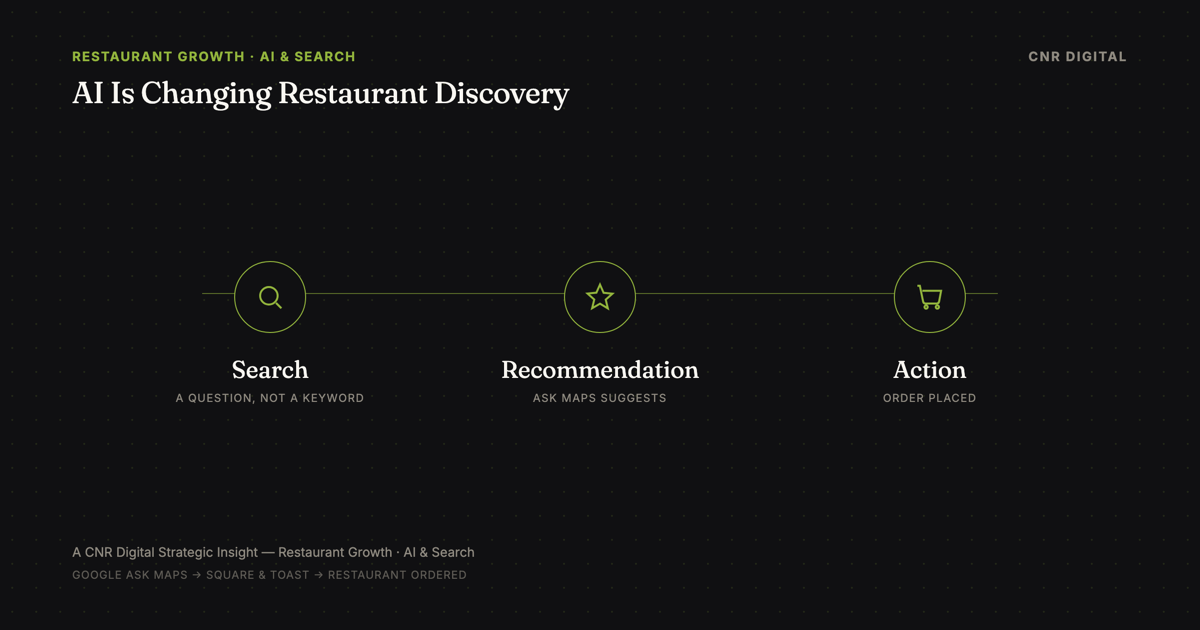
Together, however, they create a stronger digital foundation for a world in which search engines and AI systems increasingly help customers move through:
SEARCH → RECOMMENDATION → ACTION
That is where restaurant discovery is heading.
CNR Digital's restaurant website and growth system is built around that same foundation: accurate, consistent restaurant information across the website, Google Business Profile and ordering paths that both customers and AI systems can rely on.
Sources
- Google: Ask Maps gets more helpful with food ordering and more (August 6, 2026)
- Google: Ask Maps and immersive navigation (March 12, 2026)
- Square: Square and Google Deepen Collaboration to Support the Future of Food Ordering (August 6, 2026)
- Toast: Arriving Now: AI-Powered Toast Ordering on Google Maps (August 6, 2026)
Frequently Asked Questions
Can Google Maps now order food with AI?
Yes. Google's Ask Maps can now help users find restaurants that match a food request and, after a restaurant is selected, add the requested dish to a cart for the customer to review and complete. Food ordering is currently rolling out in the United States.
Which restaurant platforms work with Ask Maps food ordering?
Google says food ordering is rolling out with Square and Toast, with Uber Eats support coming soon.
Is Ask Maps food ordering available outside the United States?
Not yet, according to Google's August 6, 2026 announcement. The broader Ask Maps product is available much more widely, but Google says food ordering is currently rolling out in the U.S., with more countries planned.
How does a restaurant rank in Google Ask Maps?
Google has not published a dedicated set of Ask Maps restaurant-ranking factors. Restaurant owners should be cautious about anyone claiming a guaranteed formula. Maintaining accurate Business Profile information, menus, operating details, reputation and a useful website is a sensible foundation, but none of it guarantees Ask Maps inclusion.
Does my restaurant need Square or Toast to appear in Ask Maps?
Square says U.S. food-and-beverage sellers with an activated Google Business Profile can surface in Ask Maps and receive the new ordering flows. Toast has also announced direct Ask Maps ordering integration. Ask Maps discovery and these specific ordering integrations should not be treated as the same thing; Google has not stated every restaurant must use Square or Toast simply to be mentioned in an Ask Maps recommendation.
Should restaurants change their menu descriptions for AI search?
Restaurants should prioritize accurate, useful menu information for customers. The new ordering experience makes clear menu data more operationally important, but Google has not stated that particular wording or longer descriptions improve Ask Maps rankings.
Do restaurant websites still matter with Ask Maps?
Yes. A restaurant website remains an owned source of detailed information about menus, experiences, reservations, events, catering, private dining, brand story and other offerings. It should complement Google Maps and third-party platforms rather than compete with them.
Opening a Restaurant?
Build the Digital Foundation Before Customers Start Searching.
AI is changing how customers discover restaurants, but the fundamentals still matter: a strong website, accurate restaurant information, clear menus, local visibility, reviews and frictionless paths to reserve or order.
CNR Digital helps new restaurants build that foundation around opening day and what comes after, so your digital presence is ready as customers start searching, comparing and deciding where to eat.
Get My Free Website ConceptContinue Reading
Related Insights
Restaurant Growth
Opening a Restaurant in New Jersey or New York? Your First 90 Days Digital Launch Checklist
Opening day is only the beginning. Use this 90-day digital launch checklist to build your restaurant website, local search presence, reviews, reservations and customer relationships from the start.
Restaurant Growth
Restaurant Website Design in New Jersey: What Your Website Needs to Turn Searches Into Reservations
A restaurant website should do more than show your menu. Learn what New Jersey restaurants need to turn local searches into reservations, visits and repeat customers.
Restaurant Growth
Should Restaurants Use AI-Generated Food Photos? What Owners Need to Consider
AI can make restaurant marketing faster and cheaper, but should it create the food customers think they're ordering? Here's where AI helps, where synthetic menu images create trust risk, and the line restaurant owners should avoid crossing.