
Restaurant Growth
Opening a Restaurant in New Jersey or New York? Your First 90 Days Digital Launch Checklist
Opening a restaurant creates something most businesses spend months trying to generate: attention.
People notice the new sign. Friends share the opening. Local customers search for the restaurant. Instagram posts circulate. Early guests take photos. Reviews begin appearing. People want to know what the menu looks like, when you open and whether they can get a reservation.
The mistake is assuming that attention will last on its own.
For a new restaurant, the first 90 days should be used to turn opening-day attention into a digital foundation that continues helping customers discover you, trust you, choose you, return and stay connected.
The specific platforms may change by market (Jersey City, Hoboken, Newark, Bayonne, New Brunswick, Manhattan, Brooklyn, Queens or somewhere else entirely), but the underlying customer journey does not.
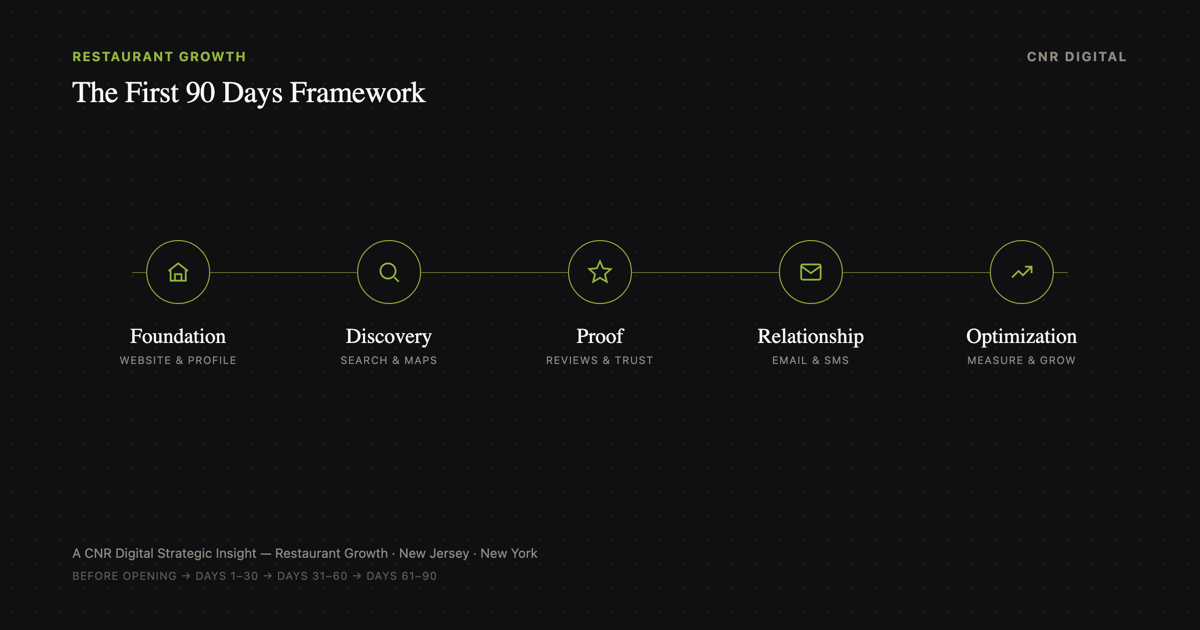
A practical digital framework for the first 90 days is:
CNR Digital's First-90-Days Framework
Your goal is not to launch every possible marketing tactic.
Your goal is to make sure the attention surrounding your restaurant has somewhere useful to go.
Before Opening: Build the Foundation Before You Need the Traffic
Restaurant owners understandably spend the months before opening focused on construction, permits, staffing, suppliers, equipment, menus and operations.
Digital often gets pushed to the final week.
That is a mistake.
Customers can start searching for a restaurant long before they eat there. A sign on a storefront, a local-news mention, an Instagram post or simple word of mouth can generate curiosity before opening day.
Google also allows a business to enter a future opening date. Once the Business Profile has been verified, Google says the profile can begin appearing 90 days before the opening date.
That means your digital opening can begin before your physical opening.
1. Give the Restaurant an Owned Digital Home
Your restaurant website should exist to answer questions and move people toward action.
A prospective guest should quickly understand:
- What is this restaurant?
- What kind of food or experience does it offer?
- Where is it?
- When does it open?
- What does the menu look like?
- What does the atmosphere feel like?
- Can I reserve?
- Can I order?
- How do I get there?
- How can I stay connected?
This is why a restaurant website should be treated as more than an online brochure.
It is the destination that other channels can point toward:
Google → Website Google Maps → Website Instagram → Website TikTok → Website Local press → Website Word of mouth → Website
OpenTable similarly recommends restaurant websites make menus easy to access, communicate the restaurant's story and provide obvious reservation paths.
For a restaurant owner, the strategic question is therefore not:
"Do we have a website?"
It is:
"Does the website make it easier for an interested customer to become a guest?"
For a deeper look at what the website itself needs to answer that question, see CNR Digital's guide to restaurant website design in New Jersey.
2. Establish Your Google Business Profile Before Opening
For a local restaurant, Google Search and Google Maps can become important discovery surfaces.
Set up your Business Profile carefully.
Make sure the information reflects the actual restaurant:
- correct business name
- accurate address
- appropriate restaurant category
- opening date
- website
- phone number when available
- photographs
- menu information as it becomes ready
- reservation or ordering options where applicable
Do not fill the profile with awkward keywords just because you want to rank.
Accuracy is the starting point.
Your website, Google Business Profile, social profiles and reservation information should tell customers the same story.
If Google says you open at 8 a.m., Instagram says 9 a.m. and your website still says "coming soon," you're creating unnecessary uncertainty exactly when people are trying to decide whether to visit.
Build the Customer Action Before You Build More Awareness
Marketing attention is much less valuable if the next step is confusing.
Ask:
What is the most valuable action a prospective customer can take right now?
For one restaurant, it may be:
Reserve a Table
For another:
Order Online
Or:
Join the Waitlist View the Menu Get Directions Join the Opening List Book Private Dining
The right action depends on the restaurant.
A reservation-led restaurant in Hoboken may need a different customer journey from a fast-casual concept in Newark or a coffee shop in Jersey City.
The important principle is simple:
Don't make customers figure out what to do next.
Make the next step obvious.
Days 1–30: Turn Opening Attention Into Proof
Once the doors open, your marketing changes.
Before opening, you're selling an expectation.
After opening, customers can experience the real restaurant.
That creates something extremely valuable: evidence.
Actual food. Actual guests. Actual photography. Actual reviews. Actual questions. Actual customer behavior.
Use it.
3. Replace "Coming Soon" With the Real Restaurant
Your digital presence should change as quickly as the restaurant does.
Review your website, Google profile and key discovery platforms.
Update:
- operating hours
- menu
- reservation availability
- ordering links
- photographs
- contact information
- location details
- recurring experiences
- FAQs
- private dining or catering information if applicable
On photographs specifically: once you have real photos of real dishes, they're worth more than a polished AI-generated substitute. See CNR Digital's take on AI-generated food photos for where AI genuinely helps and where it creates trust risk instead.
One useful rule is:
If customers repeatedly ask your staff a question, your digital experience should probably answer it too.
Maybe people keep asking whether you serve brunch.
Maybe they can't tell whether reservations are required.
Maybe parking is confusing.
Maybe they want to know whether you accommodate a particular dietary need.
Opening month creates real customer research.
Use it to improve the website.
4. Start Building Genuine Review Momentum
Reviews become especially important for a restaurant customers have never tried before.
Someone deciding between two unfamiliar restaurants may look at ratings, photographs and customer comments before ever opening either website.
Create an intentional process for asking satisfied customers to share genuine feedback.
That could mean an appropriate post-visit follow-up, a simple review link or another frictionless method.
Do not manufacture reviews.
Do not pressure customers into leaving only positive feedback.
The objective is to make it easy for real customers who want to share their experience to do so.
Then read the reviews.
Reviews are not just reputation assets.
They're customer research.
If guests repeatedly mention the same dish, atmosphere, service moment or experience, that is useful marketing information.
If several people describe the same frustration, that is useful operational information.
Your early review strategy should therefore serve two purposes:
Reputation + Learning
5. Start Measuring How Customers Find and Use the Website
You do not need a 40-page dashboard in month one.
But you should start collecting enough information to answer useful questions.
For example:
- Which pages receive the most traffic?
- What organic search queries are generating impressions?
- Which landing pages bring customers into the site?
- Are people clicking the reservation button?
- Are visitors reaching ordering platforms?
- How many users view the menu?
- Is Instagram driving meaningful website traffic?
- Which devices are customers using?
- Which pages send people toward the restaurant's most valuable actions?
The goal is not more data.
The goal is better decisions.
An owner should eventually be able to distinguish:
"People aren't discovering us."
from:
"People are discovering us, but they aren't taking the next step."
Those are very different problems.
Days 31–60: Turn Guests Into an Audience You Can Reach Again
After the opening rush, a new question becomes important:
How many of the people who already discovered your restaurant can you reach again?
A customer visits once.
They enjoy the experience.
Then what?
If the entire customer relationship lives inside Instagram, Google, a reservation platform or a delivery marketplace, the restaurant remains heavily dependent on somebody else's distribution.
Those platforms can be extremely valuable.
But they should not be the only relationship.
6. Start Building a Permission-Based Customer Audience
Create legitimate opportunities for customers to voluntarily join your restaurant's email or SMS audience.
Depending on the concept, reasons to join might include:
- new menu announcements
- weekend brunch
- events
- chef dinners
- happy hour
- holiday reservations
- private dining
- catering
- seasonal experiences
- new locations
- opening updates
The purpose should not be to collect as many phone numbers as possible.
The purpose is to build an audience that has actually asked to hear from the restaurant.
Then respect that permission.
A direct customer relationship becomes especially useful once opening-day novelty begins fading.
Instead of hoping Instagram shows your next brunch post to the right people, you can communicate appropriately with customers who already expressed interest in the restaurant.
7. Build Search Visibility Around What the Restaurant Actually Offers
Once you're open, you also have more information about what customers respond to.
That can guide local SEO.
A breakfast concept in Jersey City may discover that brunch generates particularly strong interest.
A restaurant in Manhattan may receive frequent questions about private dining.
A Hoboken restaurant may develop a strong happy-hour experience.
A Newark restaurant may build a meaningful catering business.
Those can become legitimate search and website opportunities.
Create content around real offerings and real customer intent.
Do not create dozens of nearly identical pages swapping city names.
If you're in Jersey City, don't create thin pages claiming to be a restaurant in Jersey City, Hoboken, Bayonne, Newark and every other nearby market simply to manipulate search rankings.
Instead, make it exceptionally clear:
- what your restaurant is
- where it actually is
- what it genuinely offers
- what experiences customers can have there
CNR Digital's broader guide to local SEO for New Jersey small businesses explains this discovery-to-conversion relationship in more detail.
Days 61–90: Stop Guessing and Start Optimizing
By the third month, you know things about the restaurant that you couldn't possibly know before opening.
You have real guests. Real feedback. Real website behavior. Real search queries. Real reservation patterns. Real questions.
This is when your digital strategy should become more intelligent.
8. Audit the Entire Customer Journey
Act like a customer who has never heard of your restaurant.
Search for it. Look at the Google Business Profile. Open the website on your phone. Try to find the menu. Try to reserve. Try to order. Look for the address. Check the hours. Read the reviews. Try to join the restaurant's email list.
Then ask:
- Is the information accurate?
- Does the website reflect the actual restaurant?
- Is anything confusing?
- Is the primary action obvious?
- Is the menu easy to use on mobile?
- Are reservation paths clear?
- Are customers leaving the website unnecessarily?
- Are reviews easy to find?
- Can an interested customer stay connected?
- Are important actions being measured?
Sometimes the biggest opportunity isn't another campaign.
It may simply be reducing the distance between:
"That restaurant looks interesting."
and:
"I just booked a table."
9. Decide What Deserves Investment Next
One of the most expensive mistakes a growing business can make is assuming every problem requires more marketing.
Suppose website traffic is increasing but reservations aren't.
More traffic may not be the first solution.
The reservation journey may need improvement.
Suppose customers frequently search for catering but your website barely mentions it.
That's an opportunity.
Suppose brunch is becoming one of the restaurant's strongest experiences.
That may deserve its own landing experience.
Suppose Instagram performs well but Google visibility remains weak.
That suggests a different priority.
The right next step could be:
- stronger local SEO
- improved reservation experience
- catering content
- private dining
- events
- brunch
- email campaigns
- SMS communication
- Google review growth
- menu improvements
- new photography
- conversion optimization
- measurement improvements
The first 90 days give you enough evidence to stop treating digital growth as a collection of guesses.
A New Jersey Example: Legacies Breakfast Bar
CNR Digital applied this customer-journey approach to a website concept built around Legacies Breakfast Bar, a real restaurant in Jersey City, New Jersey, shown here as an example of the thinking, not a completed client project.
Legacies had recently opened its Jersey City location.
The opportunity went beyond putting a menu online.
A new restaurant like this is simultaneously beginning to build awareness, local reputation, search visibility, reviews, reservations, customer relationships and repeat business.
The concept CNR Digital built is a restaurant-focused digital experience designed to support that broader journey.
Discover: Give customers arriving from search, social media and word of mouth a strong digital destination.
Explore: Help prospective guests understand the food, menu, atmosphere and restaurant story.
Choose: Make important actions, including reservations, ordering and visit information, easy to find.
Trust: Bring customer reputation and review signals into the experience.
Connect: Create opportunities for customers to voluntarily join permission-based email and SMS communication.
Return: Build a digital foundation that can continue changing alongside menus, events, brunch, promotions, customer communication and the restaurant itself.
The objective of a concept like this isn't a website that disappears once it launches.
It's infrastructure designed to grow with the restaurant.
That is the same way a new restaurant should think about its first 90 days.
Your New Restaurant's First 90 Days at a Glance
Before Opening — Foundation
- Establish your website
- Set up accurate Google Business Profile information
- Add your future opening date when appropriate
- Publish location and opening information
- Add the menu as it becomes ready
- Establish reservation or ordering paths
- Set up appropriate measurement
- Create ways for interested customers to stay connected
Days 1–30 — Proof
- Replace pre-opening information with real restaurant content
- Keep hours and menu information current
- Add high-quality restaurant photography
- Establish a genuine review process
- Monitor website and search behavior
- Track reservation and ordering actions
- Learn from recurring customer questions
Days 31–60 — Relationship
- Build permission-based email and SMS audiences
- Give guests relevant reasons to stay connected
- Strengthen search content around real restaurant experiences
- Identify repeat-visit opportunities
- Continue developing reputation and reviews
Days 61–90 — Optimization
- Audit the complete digital customer journey
- Review search visibility
- Identify reservation or ordering friction
- Understand which experiences customers respond to
- Find gaps in the website
- Prioritize the next growth opportunities
- Build the restaurant's next 90-day digital plan
What Should a New Restaurant Have by Day 90?
By the end of the first 90 days, a new restaurant does not need a perfect marketing machine.
It should have a functioning digital foundation.
At minimum, the restaurant should be moving toward:
An owned digital destination: A website that accurately represents the restaurant and helps customers take action.
A strong local-discovery foundation: Accurate Google information and website content that clearly communicates the restaurant's location, cuisine and experiences.
A developing reputation: A repeatable and ethical approach to generating opportunities for genuine customer reviews.
Clear conversion paths: Reservations, ordering, directions, inquiries or whatever customer actions matter most.
An owned audience: Permission-based ways for customers to remain connected beyond social and third-party platforms.
Useful measurement: Enough visibility to understand how customers discover the restaurant and what they do next.
A process for improvement: A digital presence that changes as the restaurant changes.
That's considerably more valuable than simply saying:
"Our website launched."
Opening Day Is the Beginning of Your Digital Strategy
Opening a restaurant is an enormous accomplishment.
But opening day should not be the finish line for the digital experience.
A guest may hear about you from a friend, search for you on Google, see your Instagram, visit the website, explore the menu, reserve through another platform, walk into the restaurant, leave a review and come back three months later for brunch.
To that customer, those are not separate marketing channels.
They're one relationship with the restaurant.
Your digital strategy should be built the same way.
The strongest first 90 days are not about launching as many campaigns as possible.
They're about turning temporary opening attention into something that compounds:
FOUNDATION → DISCOVERY → PROOF → RELATIONSHIP → OPTIMIZATION
Build those pieces well, and your restaurant leaves its opening period with something more valuable than buzz.
It leaves with a digital foundation designed to help people keep finding you, choosing you and coming back.
See how CNR Digital's restaurant website and growth system approaches that full first-90-days journey in one managed system.
Frequently Asked Questions
When should I start marketing a new restaurant before it opens?
Start building the digital foundation before opening day. Your website, Google Business Profile, location information, opening details and customer-interest capture can begin before the doors open. Google currently allows a verified Business Profile with a future opening date to start appearing 90 days before that opening date.
When should a new restaurant launch its website?
Ideally, the website should exist early enough to give people who hear about the upcoming restaurant a reliable place to learn about the concept, location and opening. It can begin relatively simple and evolve as menus, photography, reservations and other information become available.
When should a restaurant create its Google Business Profile?
A restaurant can establish its Business Profile before opening and enter a future opening date. Google's current guidance allows the date to be entered up to a year in advance, with the verified profile becoming eligible to appear 90 days before opening.
Does a new restaurant need a website if it already has Instagram?
Instagram can be an excellent awareness channel, but it is not a replacement for an owned website. A restaurant website gives the business control over its brand, menu, search content, location information, reservation paths, customer capture and broader digital experience.
How can a new restaurant get its first Google reviews?
Focus first on delivering experiences customers genuinely want to recommend. Then create a simple, ethical process that makes it easy for satisfied guests to leave feedback. Do not buy, manufacture or pressure customers into positive reviews.
What should a restaurant measure during its first 90 days?
Start with business-relevant behavior: search visibility, website entrances, menu engagement, reservation clicks, ordering clicks, directions, inquiries, email/SMS opt-ins and other meaningful customer actions. The goal is to understand where customers come from and what happens after they discover the restaurant.
What happens after the first 90 days?
Use what you learned to prioritize the next phase. That may involve stronger SEO, review growth, brunch, events, catering, private dining, customer retention, conversion optimization, additional content or other opportunities supported by real customer behavior.
Opening a Restaurant?
Build the Digital Foundation Around It.
Opening day gets people's attention. What happens next determines whether your restaurant keeps getting discovered, chosen and remembered.
CNR Digital helps new restaurants build the digital foundation around the customer journey: from a premium restaurant website and search foundation to reservations, Google review growth, permission-based email/SMS customer capture and ongoing digital strategy.
See the New Restaurant Growth SystemContinue Reading
Related Insights
Restaurant Growth
Restaurant Website Design in New Jersey: What Your Website Needs to Turn Searches Into Reservations
A restaurant website should do more than show your menu. Learn what New Jersey restaurants need to turn local searches into reservations, visits and repeat customers.
Restaurant Growth
Google Maps Can Now Help Order Food With AI. Here's What Restaurant Owners Should Do.
Google's Ask Maps can now help customers find a restaurant and order food through AI conversation. Here's what actually changed, what's confirmed and what restaurant owners should do next.
Restaurant Growth
Should Restaurants Use AI-Generated Food Photos? What Owners Need to Consider
AI can make restaurant marketing faster and cheaper, but should it create the food customers think they're ordering? Here's where AI helps, where synthetic menu images create trust risk, and the line restaurant owners should avoid crossing.