
Local Business Growth
Local SEO for New Jersey Small Businesses: How to Get Found and Turn Searchers Into Customers
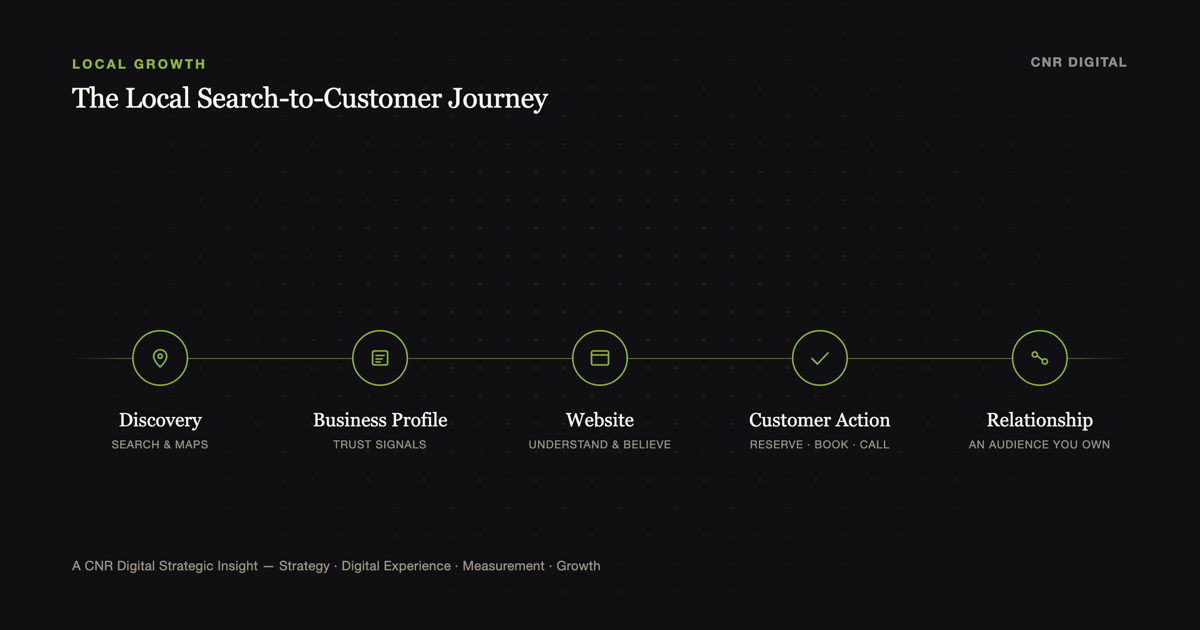
When someone nearby searches Google for a restaurant, salon, barbershop, fitness studio, boutique, professional service or another local business, your goal is not simply to "rank."
Your goal is to become the business they choose.
That distinction matters.
Effective local SEO connects discovery, credibility and conversion. Your Google Business Profile helps people discover you. Your website helps them understand and trust you. Reviews reduce uncertainty. Clear calls to action make it easy to reserve, book, call, visit or inquire.
For New Jersey small businesses, local SEO should therefore be treated as part of a larger customer-acquisition system, not an isolated marketing tactic.
What Is Local SEO?
Local SEO is the process of improving a business's visibility when people search for products or services in a particular geographic area.
Someone might search:
- "breakfast restaurant Jersey City"
- "barbershop near me"
- "salon Montclair NJ"
- "fitness studio Hoboken"
- "orthodontist Bergen County"
- "boutique near me"
Google then has to determine which businesses are most relevant to that search.
Google says local results are primarily determined by relevance, distance and prominence.
Relevance is how closely a business matches what someone wants. Distance considers the relationship between the searcher's location and businesses that could satisfy the search. Prominence reflects how well known a business appears to be, with signals including links and reviews.
That means there is no single switch that makes local SEO work.
A stronger local presence is created by multiple signals working together.
The Biggest Local SEO Mistake: Focusing Only on Rankings
Suppose a restaurant moves from position seven to position three for a valuable local search.
That sounds positive.
But what happens next?
If someone clicks through and finds an outdated menu, confusing reservation process, missing hours, weak photography or a website that barely works on mobile, the ranking did its job, but the business may still lose the customer.
The same problem appears in other industries.
A salon can appear in Maps but make booking unnecessarily difficult. A professional practice can generate website traffic without giving visitors a clear reason to inquire. A boutique can build a large Instagram following while giving customers no strong owned destination for discovering products, events or store information.
This is why CNR Digital approaches local growth as a search-to-customer system.
There are four stages:
Discovery → Trust → Action → Relationship
The CNR Digital Framework
Local SEO primarily creates discovery. Sustainable digital growth requires the other three stages too.
1. Build a Complete Google Business Profile
For many local customers, your Google Business Profile is one of the first experiences they will have with your company.
Before they ever reach your website, they may see your:
- business name
- category
- address
- hours
- phone number
- photos
- reviews
- website
- directions
- services or products
Google specifically recommends keeping business information complete and accurate because better information helps it understand and match businesses with relevant searches.
Start with the fundamentals.
Choose the most accurate primary category. Add relevant secondary categories where appropriate. Keep operating hours current. Use genuine photos. Make sure the website and phone information are correct. Describe the business clearly instead of stuffing the profile with awkward keywords.
Think about the profile from the customer's perspective.
If someone discovered your business for the first time today, would the profile give them enough confidence to take the next step?
Keeping this information accurate matters beyond traditional search, too: see our guide on incorrect business information in Google AI if you've noticed Google's AI features describing your business inaccurately.
2. Make Your Website Reinforce What Google and Customers Need to Understand
Your website and Google Business Profile should tell the same story.
If you operate a restaurant in Jersey City, your website should make it obvious what the restaurant is, where it is located, what customers can expect and how they can reserve a table or visit. If you're opening a new restaurant, CNR Digital's 90-day digital launch checklist walks through the customer journey in more detail, or see CNR Digital's guide to restaurant website design for what the website itself needs to convert that discovery into reservations.
If you own a salon in Montclair, visitors should quickly understand your services, location, experience and booking options.
Search optimization becomes much harder when the website itself is vague.
Build pages around legitimate customer needs. Depending on the business, those may include:
- services
- menus
- products
- reservations
- appointments
- locations
- events
- frequently asked questions
- contact information
- business story
Do not create dozens of nearly identical pages with different New Jersey city names simply to target keywords.
A useful local page should exist because the business genuinely serves that location or because there is meaningful information for customers in that market.
3. Turn Your Website Into a Conversion Experience
Getting found is only half the job.
Once someone reaches the website, ask one question:
What should this person do next?
For a restaurant, that might be:
Reserve a Table
For a salon:
Book an Appointment
For a professional practice:
Schedule a Consultation
For a boutique:
Shop the Collection or Visit the Store
The primary action should be obvious.
Your mobile experience is especially important because local searches frequently happen in situations where customers want an immediate answer: Where are you? Are you open? Can I book? What does the menu look like? How do I get there?
Do not make visitors hunt for these answers.
A premium website is not simply one that looks attractive. It reduces the distance between customer interest and customer action.
4. Build a Consistent Review System
Reviews serve two jobs simultaneously.
They provide potential customers with social proof, and they contribute to the broader signals surrounding a business's local presence. Google explicitly notes that review quantity and positive ratings can contribute to local prominence.
But review growth should not depend on remembering to ask occasionally.
Build a process.
Identify the point at which a satisfied customer is most likely to provide feedback. Make requesting the review simple. Train the appropriate team members. Where appropriate, automate the follow-up.
The objective is not to manufacture reviews.
It is to make it easier for genuine satisfied customers to share their experiences consistently.
And once reviews arrive, pay attention to what customers repeatedly mention. Reviews are not only a reputation asset. They are customer research.
5. Don't Let New Customer Opportunities Disappear
Local SEO can create visibility, but poor customer response can erase the value of that visibility.
Imagine investing in your website and Google presence, generating an inquiry and then taking two days to respond.
Or receiving a call while the business is busy and never following up.
That is not primarily an SEO problem anymore. It is a customer-journey problem.
Businesses should think beyond traffic and consider what happens after a customer raises their hand.
Where do inquiries go?
Who receives them?
How quickly does someone respond?
What happens after a missed call?
Does customer information disappear after the interaction, or does it become part of a database the business can use, with appropriate permission, to communicate with customers again?
The strongest digital systems connect marketing to operations.
6. Build an Audience You Own
Google and social platforms are valuable discovery channels, but they are rented distribution.
Your customer database is different.
When customers voluntarily provide contact information and permission to communicate, your business gains a direct relationship that does not depend entirely on an algorithm showing your next post.
For a restaurant, that could support communication around events or new menu experiences.
A salon might communicate openings or new services.
A fitness studio might promote programs or classes.
A boutique might announce new arrivals.
Local SEO can therefore create more than a first visit. Connected properly, it can help create the beginning of a customer relationship.
7. Measure Business Outcomes, Not Just Rankings
Rankings matter, but they should not be the final scorecard.
Measure the customer behaviors that visibility creates.
Depending on your business, useful metrics may include:
- non-branded search impressions
- local search queries
- organic website visits
- Google Business Profile interactions
- calls
- direction requests
- reservation clicks
- appointment bookings
- inquiries
- online orders
- email or SMS signups
- completed purchases
Then connect those actions to business outcomes wherever possible.
This changes the conversation from:
"Are we ranking?"
to:
"Is our digital presence generating more opportunities for the business?"
That is a much more valuable question.
What Should a New Jersey Small Business Prioritize First?
If your local digital presence is underdeveloped, do not attempt twenty disconnected tactics simultaneously.
Start with the customer journey.
First, make sure people can discover you.
Complete and strengthen your Google Business Profile and ensure Google can clearly understand what you do and where you operate.
Second, make sure they trust what they find.
Your website, photography, reviews, business information and overall presentation should reinforce credibility.
Third, make taking action simple.
Reservations, bookings, calls, directions, orders and inquiries should require as little unnecessary friction as possible.
Fourth, build a follow-up system.
Respond to opportunities quickly and begin building direct customer relationships.
Finally, measure what happens.
Use the data to determine what deserves improvement next.
- 1
Get discovered.
Complete and strengthen your Google Business Profile and ensure Google can clearly understand what you do and where you operate.
- 2
Build trust.
Your website, photography, reviews, business information and overall presentation should reinforce credibility.
- 3
Make action simple.
Reservations, bookings, calls, directions, orders and inquiries should require as little unnecessary friction as possible.
- 4
Build a follow-up system.
Respond to opportunities quickly and begin building direct customer relationships.
- 5
Measure what happens.
Use the data to determine what deserves improvement next.
That sequence is more useful than chasing isolated SEO tactics because it follows the same journey your customers follow.
Local SEO Is Really About Building a Stronger Digital Business
The best local SEO strategy is not one that generates the largest ranking report.
It is one that helps more of the right customers discover your business, understand why they should choose you and take the next step.
That requires more than keywords.
It requires your Google presence, website, reputation, customer response and measurement to work together.
For established New Jersey small businesses, that is the larger opportunity: not simply becoming more visible, but turning digital visibility into a repeatable business-growth system.
Frequently Asked Questions
Does a small business still need a website if it has a Google Business Profile?
For most established local businesses, yes. A Google Business Profile is an important discovery surface, while your website gives you much greater control over your brand, services, customer journey, content and conversion experience. The two should reinforce one another.
Does having more Google reviews help local SEO?
Google states that review count and positive ratings can contribute to local prominence. Reviews also help prospective customers evaluate a business, making them valuable for both visibility and conversion.
Should I create a page for every New Jersey city I want to rank in?
Not automatically. Location pages should provide legitimate value and reflect real business operations or meaningful service-area information. Repeating essentially identical content with different city names creates a poor customer experience and is not a strong long-term SEO strategy.
What should I measure from local SEO?
Measure visibility and business actions. Search impressions and rankings provide useful context, but calls, reservations, bookings, inquiries, direction requests, orders and other meaningful conversions show whether visibility is creating business opportunity.
Build a Stronger Local Growth System
Your Business Needs More Than Visibility.
Getting discovered is important. What happens after customers find you matters just as much.
CNR Digital’s Brand Growth System brings your website, visibility, customer response, reviews and ongoing digital improvement together so your online presence can do more than simply exist.
Explore the Brand Growth SystemPrefer to talk through your digital presence first? Start a conversation with CNR Digital.
Continue Reading
Related Insights
Restaurant Growth
Restaurant Website Design in New Jersey: What Your Website Needs to Turn Searches Into Reservations
A restaurant website should do more than show your menu. Learn what New Jersey restaurants need to turn local searches into reservations, visits and repeat customers.
Search & AI Discovery
Google AI Is Showing Wrong Information About My Business. What Can I Do?
Google AI is showing customers something inaccurate about your business. Learn what you control, what you can influence, how to report errors and how to strengthen your digital source of truth.
Restaurant Growth
Opening a Restaurant in New Jersey or New York? Your First 90 Days Digital Launch Checklist
Opening day is only the beginning. Use this 90-day digital launch checklist to build your restaurant website, local search presence, reviews, reservations and customer relationships from the start.