
Websites & Conversion
Your Booking Platform Isn't Your Website: A Growth Guide for Salons, Barbers and Beauty Businesses
If you already use GlossGenius, theCut, Vagaro, Square Appointments, Fresha or another booking platform, you may reasonably ask: why would I need a separate website?
The answer is not that your booking platform is inadequate. It may be doing exactly what you hired it to do.
The more useful question is: what role should your booking platform play, and what role should your owned website play?
A booking platform can help customers choose a service, see availability and schedule an appointment. Your owned website can help someone discover your business, understand the brand, explore your work and services, meet your team, find you in local search, join your audience and decide why they should book with you in the first place.
The strongest digital setup often connects the two.
What a Booking Platform Does Well
Modern booking platforms handle a real, significant part of running a salon or barbershop. Depending on the platform, that can include appointment scheduling and availability, service menus and pricing, payments, automated reminders, client profiles and history, portfolios, review collection, in-app discovery, rebooking prompts, and day-to-day operational management.
GlossGenius, for example, is built around salon and beauty business management with online booking built in. theCut is built specifically around barber discovery and booking. Vagaro, Square Appointments and Fresha each bring their own mix of scheduling, payments and client tools.
Functionality varies by platform, and it's worth checking what your specific plan actually includes rather than assuming every platform offers the same thing. But for the appointment and operations layer, a good booking platform genuinely earns its place in the business.
So Why Would a Salon or Barbershop Need Its Own Website?
Because booking is only one part of customer acquisition and brand growth.
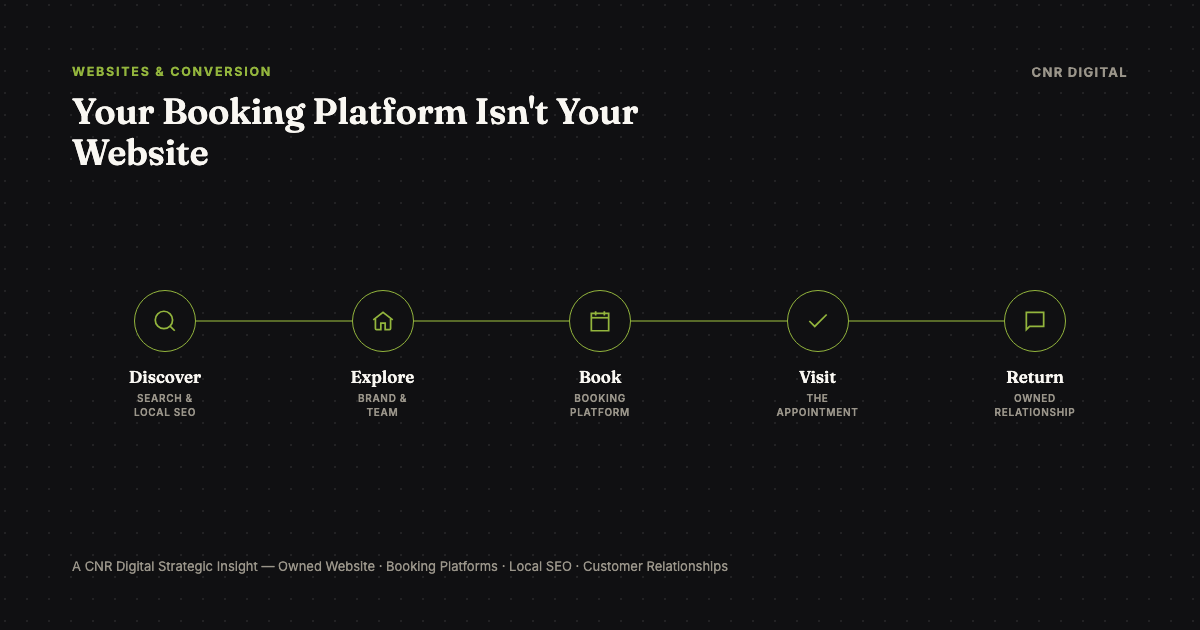
A customer's actual path usually looks like this:
Discovery → Trust → Exploration → Booking → Experience → Relationship → Return
A booking platform is especially strong around the booking and operations layer, in the middle of that journey. A website can strengthen everything around it, before someone is ready to book and after they've become a customer.
1. Your Website Gives the Business an Owned Digital Home
A booking-platform profile is a rented presence. It lives on someone else's platform, under someone else's rules, formatted the way that platform decides. An owned website is different: a central, permanent digital destination the business actually controls.
That doesn't mean abandoning the platforms that work. It means giving the business one home that everything else can point to, Google, social, email, SMS, press, referrals, connecting to services, products, events, team and memberships, instead of scattering that story across disconnected profiles.
2. Your Website Can Explain the Brand Beyond the Appointment
A booking screen is built to move someone toward scheduling. It's rarely the right place to explain everything a business actually is.
A barber may also run memberships, sell grooming products, host events, offer education, collaborate with other brands, or build a community around the shop. A salon may also offer extensions, bridal services, retail products, training, consultations or specialist treatments across multiple stylists.
A website gives that fuller story somewhere to live.
3. Local SEO Starts Before Someone Is Ready to Book
Long before someone opens a booking app, they're often searching Google for something like "balayage salon near me," "natural hair salon" in their city, "barber near me," "beard trim" nearby, "bridal hair" in their area, or "textured hair salon" close by.
A useful service page, clear location information, team expertise, genuine reviews and a properly set up Google Business Profile all work together here, and an owned website gives search engines more real, structured content to understand than a shared booking-platform template usually offers. For a deeper look at how that local visibility actually works, see CNR Digital's guide to local SEO for New Jersey small businesses.
4. Service Pages Can Answer Questions a Booking Menu Cannot
A booking menu is built to be short: a service name, a price, a duration. A silk press listed as "Silk Press, 90 minutes" tells a customer almost nothing about what to actually expect.
A real service page can explain who the service is for, what's included, how to prepare, what results typically look like, maintenance afterward, related services, common questions, and what happens next, whether that's loc maintenance, extensions, color, bridal work, fades or a premium grooming experience. None of that needs invented pricing to be useful; it just needs the information a booking menu was never designed to hold.
5. Your Work Deserves More Than a Social Feed
Instagram and TikTok are genuinely valuable for discovery and portfolio content. But a social feed is chronological and algorithm-dependent, not organized around what a business actually wants a prospective customer to see first.
A website gives a salon or barbershop a place to intentionally organize its strongest work: galleries, before-and-after transformations, portfolios by stylist or barber, and specialties, presented the way the business wants it seen, not however the algorithm decided to show it that week.
6. Build the Business Brand Alongside Individual Providers
This matters especially for salons and multi-barber shops, where there's an important difference between personal brand equity and business brand equity.
Individual stylists and barbers should absolutely keep benefiting from their own reputation and following. But the shop or salon should also build an identity customers recognize on its own, through provider profile pages, specialties, portfolios, individual booking links, team discovery and consistent brand presentation.
CNR Digital's work for Keeping It Handsome, a Brand Growth System client in Orange, New Jersey, is a real example of this balance. Keeping It Handsome had already built a thriving grooming destination shaped by Sir Mil The Barber's reputation and clientele, but the experience had grown well beyond the chair, into membership, events, wellness, education and community. Rather than building a traditional barbershop website, CNR Digital designed an interconnected digital experience where customers can discover the team, book grooming, explore memberships, find events and stay connected to what happens next, all while preserving the founder equity Sir Mil had already built. The strategy was never to replace what made the business successful. It was to build a digital system capable of carrying that success forward.
7. Your Website Can Capture Customers Who Aren't Ready to Book Today
Not every valuable interaction ends in an immediate appointment. Someone may love a barber's work but not need a haircut this week. Someone may research extensions for weeks before booking. Someone may just want to know when a new stylist starts taking clients, or hear about an upcoming event or product launch.
Permission-based email and SMS capture, tied to what a visitor actually showed interest in, gives a business a way to stay connected with all of those people, not just the ones ready to book today.
8. Your Website and Booking Platform Should Work Together
This is where the two systems are strongest combined, not separated.
A customer might move from Google, to a salon's service page, to its portfolio and reviews, to a "Book This Service" button that sends them directly into GlossGenius, Vagaro or whatever platform the business already uses.
Or from Instagram, to a barbershop's website, to an individual barber's profile and portfolio, to "Book With [Barber]," into theCut or the shop's existing booking system.
Or from Google, to the website, to an event page, into an email or SMS signup, with the appointment following later.
The principle holds across all three: don't recreate booking software just because you have a website. Connect the website to the booking technology that already works.
9. Keep the Customer Journey Consistent
Service names, pricing, staff names, hours, locations, policies and booking destinations should say the same thing everywhere a customer encounters them. Outdated information on a website, while the booking platform shows something different, is a fast way to lose the trust a business worked to build. The website and the booking platform need to agree.
10. Measure What Happens Before the Booking
A completed appointment isn't the only meaningful signal. Organic entrances, service-page views, portfolio engagement, provider-profile views, booking-button clicks, phone calls, direction clicks, email and SMS signups, and event registrations all tell a business something about what's actually working, well before a booking is confirmed.
What Should a Salon or Barber Website Include?
At minimum, a strong salon or barbershop website should have:
- Clear positioning: what the business is and who it's for
- Location and hours
- Services, with real descriptions, not just a price list
- A clear booking call to action
- Team or provider profiles
- A portfolio of real work
- Genuine reviews, placed where they actually help someone decide, not just as a star count
- FAQs where they're actually useful
- Contact information
- A Google Business Profile and local-search foundation that matches the website
- Mobile-optimized design
- Email or SMS capture where relevant
- Clear policies
- Products, memberships or events, if the business actually offers them
- Basic analytics to see what's working
When a Booking Platform Alone May Be Enough
To be fair to booking platforms: an independent solo provider may reasonably decide a booking-platform page is sufficient, at least for now, if referrals and social media already keep the calendar full, services are relatively simple, there's no broader offering beyond appointments, local SEO isn't currently a priority, and there's no real need yet for a wider brand or customer journey.
That can change as the business grows: a growing team, a growing brand, a new location, multiple service categories, products, events, memberships, education, a real need for search-driven discovery, customer retention, or simply wanting more control over the digital experience. That's usually the point where an independent website becomes strategically worth building.
The Goal Is Not to Replace Your Booking Platform
Keep the technology that already works. Build the owned experience around it.
Your booking platform can handle the appointment. Your website can help create the demand, trust and relationship surrounding that appointment, before someone ever opens the booking screen and after they've become a returning customer.
Frequently Asked Questions
Do I need a website if I already use GlossGenius?
GlossGenius can handle scheduling, payments and client management well. A website adds what a booking page typically doesn't: local search visibility, brand storytelling, service pages, team discovery and a destination for customers who aren't ready to book yet. The two work together rather than compete.
Do barbers need a website if they use theCut?
theCut is built for booking and client discovery within the app. An independent website gives a barber or shop a search-visible, owned home that can showcase work, explain specialties and connect every channel, social, Google, referrals, back to one destination, then send the customer into theCut to actually book.
Should my website replace my salon booking software?
No. The goal isn't to recreate booking software you already have working. Keep the booking platform for scheduling and operations, and use the website to strengthen discovery, brand and trust, then link directly into the existing booking flow.
Can I link my booking platform from my website?
Yes, and that's the intended setup. A service or team page can end with a clear "Book This Service" or "Book With [Name]" button that sends the visitor straight into GlossGenius, theCut, Vagaro, Square Appointments or Fresha, whichever the business already uses.
Does a salon website help with local SEO?
It can. A booking-platform profile page is usually a shared, templated page. An owned website with real service pages, location details and content gives search engines more to understand and rank around, working alongside your Google Business Profile rather than instead of it.
What should a barbershop website include?
At minimum: clear positioning, location and hours, services, a booking call to action, team or barber profiles, a portfolio of work, reviews, and contact information. Add products, memberships or events only if the business actually offers them.
Is Instagram enough for a salon or barber business?
Instagram is a strong discovery and portfolio channel, but it's a rented platform, not an owned one. A website gives the business a search-visible, permanent home that a social feed and algorithm changes can't take away.
Booking Handles the Appointment
Your Booking System Can Handle the Appointment. Build the Growth System Around It.
CNR Digital's Brand Growth System gives salons, barbershops and growing local businesses an owned website, search foundation, customer capture, review growth, follow-up and ongoing digital management around the tools they already use.
Explore the Brand Growth SystemPrefer to talk through your digital presence first? Start a conversation with CNR Digital.
Continue Reading
Related Insights
Websites & Conversion
Why Your Google Reviews Aren't Turning Into Enough Customers
Hundreds of five-star reviews and still not enough calls, bookings or reservations? Reviews build trust, but they don't complete the sale. Here's what's usually missing in between.
Local Business Growth
Local SEO for New Jersey Small Businesses: How to Get Found and Turn Searchers Into Customers
Local SEO is about more than ranking on Google Maps. Learn how your website, Google Business Profile, reviews and customer experience can work together to turn local searches into customers.
Local Business Growth
Opening a Second Location? 10 Website & Local SEO Updates to Make Before Launch
Opening a new location changes more than your address. Here are 10 website and local SEO updates to make before customers start searching.