
Websites & Conversion
Why Your Google Reviews Aren't Turning Into Enough Customers
A business can have hundreds of positive Google reviews and still feel like it should be generating more calls, bookings, reservations or inquiries.
That is because reviews solve only part of the customer journey.
Google reviews can help someone trust your business. They can support your presence on Google, give potential customers evidence from previous customers and help your business stand out when people are comparing options.
But a strong reputation does not automatically create a customer.
After someone reads your reviews, something still has to happen next.
They need to understand what you offer. They need to see that you are relevant to what they need. They need a reason to choose you. And they need a clear, low-friction way to take action.
If your reviews are strong but customer acquisition still feels weaker than it should, look at what happens after the review earns the person's attention.
Reviews Build Trust. They Don't Complete the Sale.
Think about the role a Google review plays.
Someone searches for a plumber, an auto repair shop, a restaurant, a barber, a salon, a dentist, a contractor or a local boutique.
They see several businesses.
Your rating and reviews may make you look credible. That is valuable.
Google itself says reviews can help businesses stand out and provide potential customers with useful information, and Google also recommends responding to reviews because those responses demonstrate that customer feedback matters.
But credibility is not the same thing as conversion.
A review can answer "Can I trust this business?" It usually cannot answer every other question a customer has: whether you provide exactly what they need, how much it costs, whether you're available, whether you serve their town, whether they can see examples of your work, whether they can book online, and what they should do next.
That is where the rest of your digital presence has to take over.
1. Your Website Does Not Reinforce the Reputation Customers Just Saw
One of the biggest gaps happens when the Google reputation is stronger than the website experience.
Imagine someone sees 4.9 stars and dozens or hundreds of reviews. They click the website expecting a business that looks established, trusted and current.
Instead they land on an outdated design, broken mobile formatting, old photos, missing services, outdated staff information, incorrect hours, a generic homepage or no obvious next step.
The customer experiences a disconnect. Google created trust. The website introduced doubt.
Your website should reinforce the story customers just read in your reviews. If reviewers consistently praise attention to detail, speed, customer service, expertise, atmosphere, craftsmanship, friendliness or reliability, your website should make those strengths visible, not by making exaggerated claims, but by helping visitors understand what makes the experience valuable.
The website is where reputation should become a clear customer decision.
2. Your Reviews Are Not Visible at the Right Decision Points
A common website approach is to place every review in one testimonial slider near the bottom of the homepage.
That is better than nothing.
But reviews are more persuasive when they appear where a visitor is actively deciding something.
For example, a contractor's kitchen-remodeling page can feature customer feedback related to completed remodeling work. A barber's premium-service page can show feedback describing the quality of the service and experience. A restaurant's private-dining page can include feedback from guests who held events there. An auto shop's brake-service page can reinforce trust with customer experiences relevant to repairs and communication.
The goal is not to cover every page in stars. It is to place customer evidence near the questions where trust matters.
Consider the customer's thought process: can they actually do this well? A relevant review can help answer that.
3. Your Calls to Action Are Too Weak or Too Generic
You may have earned the customer's confidence and still lose them because you make the next step difficult.
Generic buttons such as "Learn More" or "Contact Us" often provide less direction than a customer needs.
The right CTA depends on what the business actually wants the visitor to do. A restaurant might use Reserve a Table. A salon might use Book an Appointment. A contractor might use Request an Estimate. An auto shop might use Schedule Service. A professional practice might use Schedule a Consultation. A local retailer might use Visit the Store.
The action should feel like the natural next step after trust has been established.
A customer should not have to search your site to figure out how to become a customer.
4. Your Landing Page Doesn't Match What the Customer Was Looking For
Not every person reading your reviews has the same intent.
Consider an HVAC contractor with strong reviews. One searcher needs emergency AC repair. Another needs furnace replacement. Another wants annual maintenance.
Sending all three people to a generic homepage creates additional work for the visitor.
The stronger approach is to build useful pages around legitimate services and customer needs: /air-conditioning-repair, /furnace-installation, /maintenance. Now the reputation and the page can work together.
The same principle applies across industries. A salon can have pages for legitimate high-value services. An auto shop can explain its repair specialties. A restaurant can distinguish reservations, catering and private dining. A business opening a second location can provide a meaningful page for each real location.
The more closely the page matches the customer's reason for searching, the easier it is for the reputation you've already earned to influence a decision.
5. Important Business Information Is Missing or Hard to Find
Customers frequently use Google reviews while deciding whether a business is worth considering. Then they look for practical information.
If that information is difficult to find, the journey stalls.
Make important details easy to access: hours, address, phone number, service area, parking information, booking options, reservation options, services, menus, pricing or pricing context when appropriate, policies, availability and directions.
This sounds simple. It is also one of the easiest ways for a local business to lose a customer.
If your Google Business Profile says one thing and your website says another, customers are forced to decide which information is correct. That friction is unnecessary.
6. You Are Treating Reviews as the Finish Line
Getting another five-star review feels like a marketing win.
It is.
But it should not be the end of the system.
A good customer experience can create: customer → review → future customer's trust.
The stronger system continues: customer → review → future customer's trust → website visit → action → new customer.
And then: new customer → follow-up → repeat business → another genuine review.
That is a growth loop. Reviews become more valuable when they connect to customer acquisition, conversion, retention and reputation building, rather than operating as an isolated reputation metric.
7. You Are Not Responding to Reviews
Your responses are part of your public reputation too.
Google recommends replying to reviews and notes that useful responses demonstrate that a business values customer feedback.
A response does not need to be long. It should simply feel real.
Avoid posting the exact same robotic response underneath every customer. A positive response can acknowledge something specific the customer mentioned. A critical review deserves a professional, thoughtful response rather than an argument.
Remember that you are not only responding to the reviewer. Future customers may read the response too. Your handling of a difficult situation can become part of their decision.
8. You Are Getting Reviews but Not Consistently Asking for Them
Some businesses have excellent ratings but very little recent activity.
The business may still be delivering a great customer experience. It simply does not have a process for turning those experiences into reviews.
Google allows businesses to ask genuine customers for reviews and provides businesses with review-request links and QR codes. What Google does not allow is manipulating the rating. Google's review policies prohibit buying reviews, offering discounts or free products for reviews, creating fake reviews, pressuring customers to change negative reviews, or otherwise incentivizing or manipulating review activity.
The right review process is simple: provide a good experience, ask real customers for honest feedback, make the process convenient, then let the customer's genuine opinion speak for itself.
9. Your Business Isn't Capturing the Customer Relationship
A Google review lives on Google. That is useful. But Google should not be the only place where the customer relationship exists.
If someone visits your site but isn't ready to book today, do you have a way for them to stay connected? Depending on the business, that may include email, SMS, an inquiry form, an appointment request, an offer notification, event updates, a customer account, a newsletter or a consultation request.
The goal is not to collect information for the sake of having a database. The goal is to give interested people a legitimate reason to remain connected.
This becomes particularly important for businesses where customers may need time before purchasing. A homeowner considering a renovation may not request an estimate during the first website visit. Someone exploring a salon may want to review services first. A customer considering private dining may need to coordinate with other people.
A strong website gives interested people more than one way to continue the relationship.
10. You're Not Measuring What Happens After Someone Discovers You
If you only monitor review count, you are measuring reputation growth, not customer acquisition.
Those are different things.
A stronger measurement approach asks: after someone discovers the business, what happens?
Depending on your business, track website visits from Google Business Profile, calls, direction requests, appointment clicks, reservation clicks, estimate requests, contact-form submissions, online orders, email signups, SMS signups and visits to high-value service pages.
Then look at your website analytics. For example: Google → website → service page → request estimate. Or: Google → restaurant website → menu → reservation. Or: Google → salon website → service page → booking platform.
Those paths tell you far more than review count alone.
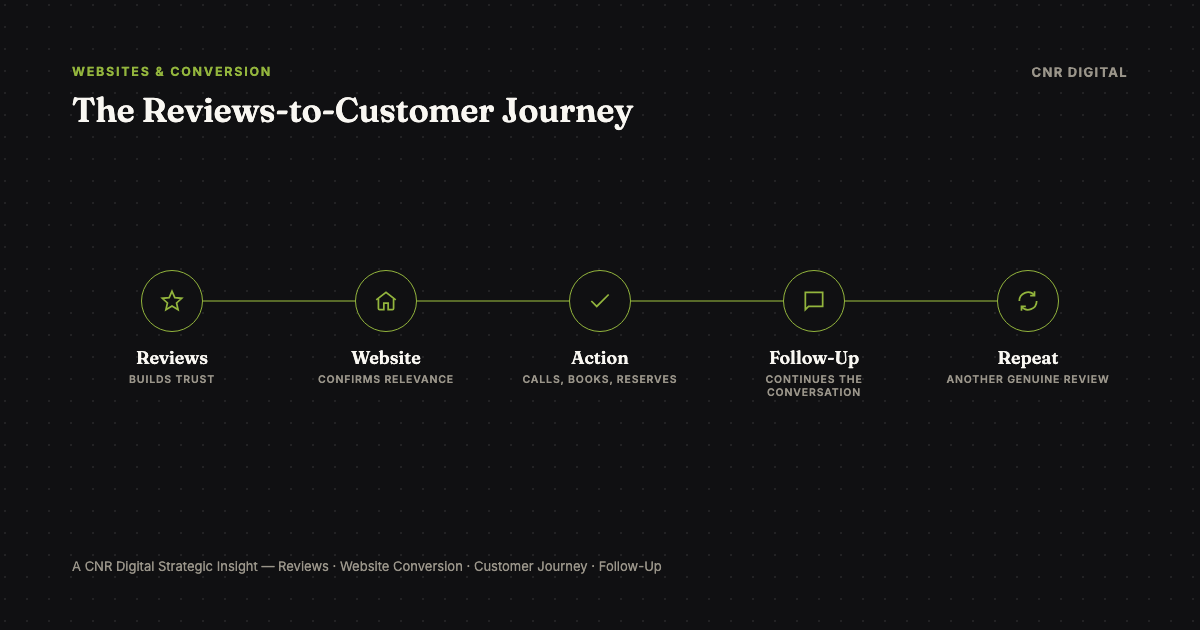
What a Better Reviews-to-Customer Journey Looks Like
A strong local-business digital journey looks something like this:
Search: someone searches for a business or service.
Reputation: reviews and your Business Profile build confidence.
Website: your website confirms what the business offers and why it is relevant.
Action: the visitor calls, books, reserves, orders or inquires.
Follow-Up: the business responds and continues the conversation.
Customer Experience: the business delivers.
Review: the satisfied customer has an easy way to leave honest feedback.
Repeat: the reputation helps influence the next prospective customer.
Reviews matter tremendously inside this system. They simply should not be expected to do every job themselves.
Should You Put Google Reviews on Your Website?
Usually, yes, when they improve the customer's ability to make a decision.
But do it intentionally.
Do not add an enormous review widget to every page simply because reviews are good. Use customer feedback where it provides context. A restaurant may highlight feedback near reservations or private dining. A salon may place reviews near service pages. A contractor may pair customer experiences with real project content. An auto shop may reinforce trust near appointment or service information.
The objective is not "look how many stars we have." It is "here is evidence that customers have trusted us for the thing you're considering."
Why Strong Reviews and a Weak Website Can Still Mean Lost Customers
A strong reputation can compensate for some weaknesses. But it cannot remove every obstacle.
If someone trusts your business but cannot understand your services, cannot find the location, cannot see your work, cannot book, cannot request a quote, cannot find current information, or cannot tell whether you serve them, the business can still lose the opportunity.
That is why local growth is not one tactic. It is a connected system.
Your reviews create trust. Your website explains the business. Your CTA creates action. Your follow-up helps convert interest. Your customer experience creates the next review.
The pieces become more powerful when they work together, the same way a local SEO strategy only works when discovery, credibility and conversion reinforce each other.
Frequently Asked Questions
Why do I have great Google reviews but not enough customers?
Reviews build trust, but trust isn't the same as conversion. After someone reads your reviews, they still need to understand what you offer, see that it's relevant to them, and have a clear, low-friction way to take the next step. If your website, calls to action, or business information don't carry that trust forward, the review earns attention that never turns into a customer.
Should I put Google reviews on my website?
Usually yes, when they improve a visitor's ability to make a decision, placed near the specific page or service the review is relevant to, not just as one generic testimonial slider. The goal is evidence at the decision point, not a star count for its own sake.
How do I get more Google reviews the right way?
Provide a genuinely good experience, then make it easy and convenient for real customers to leave honest feedback: a follow-up text, a QR code, a simple link. Google prohibits offering any incentive, financial or otherwise, in exchange for a review, and prohibits fake or manipulated reviews entirely.
Does responding to Google reviews actually matter?
Yes. Google recommends responding to reviews and notes that useful responses demonstrate that a business values customer feedback. Future customers read those responses too. A thoughtful reply to a critical review can matter as much as the review itself.
What should I measure besides review count?
Track what happens after someone discovers you: website visits from your Google Business Profile, calls, direction requests, booking or reservation clicks, estimate requests, and form submissions. Review count measures reputation growth. These measure whether that reputation is actually producing customers.
Reputation Without Conversion?
Turn Reputation Into a Customer Journey.
CNR Digital's Brand Growth System brings together a premium managed website, local search foundations, customer capture, Google review growth, follow-up and ongoing optimization, so your reputation has a stronger path to becoming actual business.
Explore the Brand Growth SystemPrefer to talk through your digital presence first? Start a conversation with CNR Digital.
Continue Reading
Related Insights
Local Business Growth
Opening a Second Location? 10 Website & Local SEO Updates to Make Before Launch
Opening a new location changes more than your address. Here are 10 website and local SEO updates to make before customers start searching.
Local Business Growth
Local SEO for New Jersey Small Businesses: How to Get Found and Turn Searchers Into Customers
Local SEO is about more than ranking on Google Maps. Learn how your website, Google Business Profile, reviews and customer experience can work together to turn local searches into customers.
Restaurant Growth
Restaurant Website Design in New Jersey: What Your Website Needs to Turn Searches Into Reservations
A restaurant website should do more than show your menu. Learn what New Jersey restaurants need to turn local searches into reservations, visits and repeat customers.