
Restaurant Growth
Restaurant Website Design in New Jersey: What Your Website Needs to Turn Searches Into Reservations
A strong restaurant website should make it easy for customers to understand the restaurant, explore the menu and experience, trust what they find and take the next action, whether that is reserving, ordering, calling or planning a visit.
That's a design job, but it isn't only a design job.
A restaurant website can look beautiful and still fail at the thing it actually needs to do.
Your Restaurant Website Has a Business Job
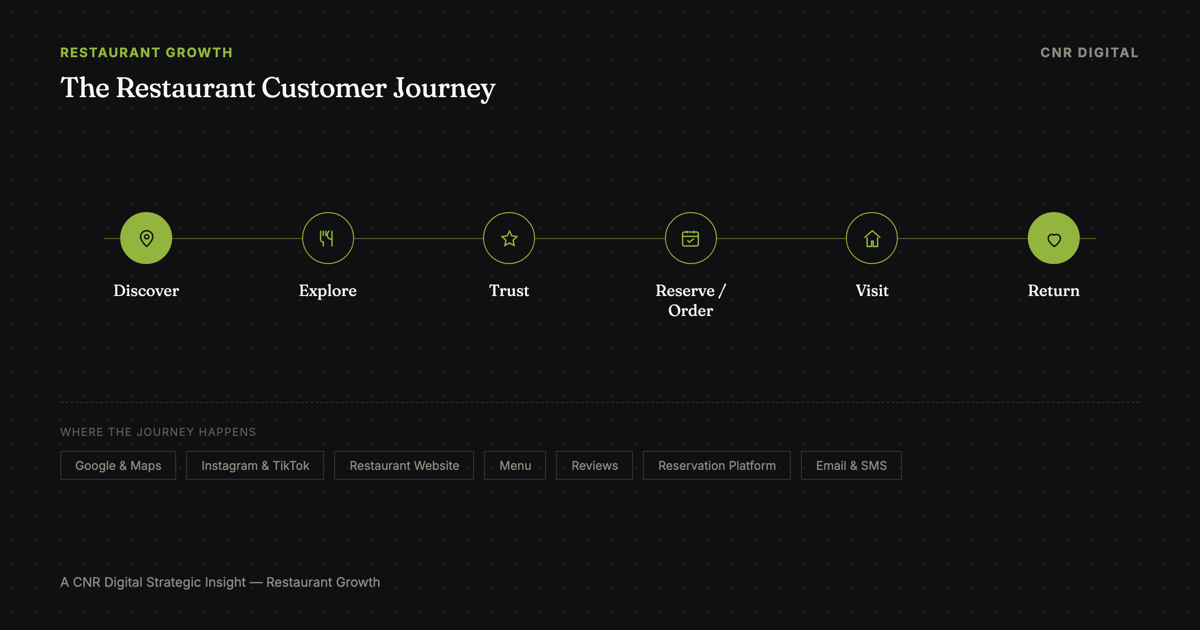
Before a customer ever sits down, they usually move through a sequence:
The Restaurant Customer Journey
They discover the restaurant through Google, Google Maps, AI search, Instagram, TikTok, local media or word of mouth. They explore the cuisine, menu, atmosphere and concept. They trust (or don't) what the reviews, photography and information tell them. They take an action: reserve or order. They visit, which depends on clear location and hours. And ideally, they return, because the restaurant found a way to stay connected.
A website that only looks good addresses one part of that sequence. A website that works addresses all of it.
That distinction (pretty website versus effective restaurant website) is where most restaurant sites in New Jersey fall short.
1. Make the Restaurant Immediately Understandable
A visitor should quickly know: What is this place, and why should I choose it?
That means the homepage needs to communicate concept, cuisine, location and atmosphere fast, through strong hero copy, real photography, consistent branding and a layout that reads clearly on a phone. Someone searching "restaurant Jersey City" or "brunch Hoboken" on their phone should not have to dig for the basics.
If a visitor has to guess what kind of restaurant they're looking at, the design has already failed the first job it had to do.
2. Make the Menu Easy to Explore
The menu is usually the second thing a customer wants, right after "what is this place."
An effective restaurant menu on the web is accurate, easy to read on mobile, clearly organized and current. Pricing context and dietary information help where relevant. What doesn't work: a menu buried in a downloadable PDF, a blurry photo of a printed menu, or a page nobody has updated since the last seasonal change.
Outdated menu information doesn't just look careless. It creates real friction: a customer who shows up expecting a dish that's no longer served, or who can't tell whether the restaurant serves brunch, is a customer who may not come at all.
3. Make Reservations or Ordering Obvious
The website's primary call to action depends on the restaurant. It might be Reserve a Table, Order Online, Order Ahead, Join the Waitlist, Call, or a Private Dining Inquiry.
Whatever it is, one primary action should usually dominate the page rather than forcing a customer to evaluate five equally weighted buttons. A visitor shouldn't have to decide which of several options is the "real" one.
4. Make Planning the Visit Effortless
Hours, address, directions, contact information, parking or transit notes and accessibility information should be easy to find without hunting.
This matters especially for local search. Someone searching for a restaurant in Jersey City, Newark, Bayonne or New Brunswick is frequently deciding right now, on their phone, often on the way somewhere. If the hours are unclear or the address requires a second search, the website has introduced exactly the kind of friction local search was supposed to remove.
5. Make the Website Feel Like the Restaurant
The physical and digital experience should reinforce each other.
Photography, typography, color, tone and storytelling should help someone understand the restaurant before they ever walk in, not simply "look nice" in the abstract, but communicate the specific concept, energy and experience the restaurant actually offers. A quiet neighborhood breakfast spot and a high-energy dinner destination shouldn't use the same visual voice.
6. Build Trust Before the Customer Arrives
Genuine Google reviews, accurate photography, an honest restaurant story and up-to-date information all shape whether a new customer trusts what they're seeing. That's also why it's worth thinking carefully before using AI-generated food photos: AI-assisted editing of a real dish photo helps; a fully synthetic image of food that was never plated creates exactly the kind of trust gap this section is about.
Trust affects conversion directly. A visitor comparing two unfamiliar restaurants will often choose the one that feels more current, more credible and more clearly represented, not necessarily the one with the fancier website. This is not a reason to manufacture reviews or inflate claims. It's a reason to keep the real information accurate and current.
7. Think Beyond the First Reservation
Instagram, TikTok, Google, reservation platforms and delivery apps are valuable, but they are rented attention. The restaurant doesn't fully control the relationship, and it doesn't always own the customer data.
A website, paired with a CRM and permission-based email or SMS, is owned infrastructure. It's how a restaurant can communicate directly with customers who've already chosen to hear from them (about a new menu, an event or a seasonal offering) without depending entirely on an algorithm to decide who sees the next post.
Not every restaurant needs every tactic here. But every restaurant benefits from having some owned way to reach the customers who already know them.
Your Restaurant Website and Local SEO Should Work Together
Local SEO helps customers discover a restaurant. The website's job is to convert that discovery into menu views, reservations, orders, directions, inquiries and repeat engagement.
The two should function as one system, not two separate projects. CNR Digital's broader guide to local SEO for New Jersey small businesses covers the discovery side of that relationship in more detail.
Increasingly, that discovery side includes conversational AI. See what restaurant owners should know about ChatGPT and restaurant reservations for how that shift changes what a restaurant's website needs to get right.
A Jersey City Example: Legacies Breakfast Bar
CNR Digital built a website concept for Legacies Breakfast Bar, a real Jersey City restaurant, around this same customer journey, shown here as an example of the thinking, not a completed client project.
The opportunity wasn't simply to put a menu online. It was to give a recently opened restaurant a digital foundation that could support discovery, credibility, reservations and an ongoing relationship with customers from day one.
See the Legacies Breakfast Bar digital experienceHow CNR Digital Approached Legacies
How CNR Digital Approached Legacies
Get Discovered: Give customers arriving from Google, social media or word of mouth a strong, branded destination.
Explore: Bring the food, menu, atmosphere and restaurant story together in one place.
Reserve: Create a clear path into the restaurant's actual reservation experience.
Plan: Make location, hours and visit information easy to understand.
Trust: Integrate reputation and customer-review signals appropriately.
Stay Connected: Lay the foundation for permission-based customer capture and ongoing communication.
The goal wasn't simply to design a nicer website. It was to show what a digital experience built around the restaurant customer journey could look like: the same framework outlined above, applied to a real Jersey City restaurant.
If you haven't opened yet: the earlier your website exists as part of the digital foundation for a new restaurant, the more of this journey it can support from opening day forward. CNR Digital's First 90 Days checklist walks through that sequence in detail.
What Should a Restaurant Fix First?
If a restaurant's website needs work, don't try to fix everything simultaneously. Work in order.
1. Accuracy. Wrong hours, an outdated menu or an old address undermine everything else on the site.
2. Mobile experience. Most restaurant searches happen on a phone. If the mobile site is slow or hard to use, nothing else matters yet.
3. Menu clarity. Make it easy to read, current and honest about what's actually served.
4. Primary conversion action. Decide what you want a visitor to do next, and make that path obvious.
5. Brand and trust. Photography, tone and visual identity should represent the restaurant honestly.
6. Local visibility. Once the website itself works, local SEO can send more of the right people to it.
7. Customer capture. Add a legitimate, permission-based way for customers to stay connected.
8. Measurement and ongoing improvement. Track what customers actually do on the site, and use it to decide what to improve next.
This sequence holds whether or not a restaurant ever works with an agency. Fixing accuracy and mobile experience first will do more for most restaurants than any amount of additional marketing spent on top of a confusing site.
The Website Is Part of the Experience, Not Just a Listing
A restaurant website is not simply something customers look at. Done well, it helps move them from discovery to trust, to a reservation or an order, to an actual visit, and eventually, to a repeat relationship with the restaurant.
That's a different job than "look attractive," and it's why restaurant website design in New Jersey deserves the same strategic attention as the menu, the space or the service. Strategy, website, local discovery, conversion, customer relationship and ongoing growth all belong to the same system.
Frequently Asked Questions
What should every restaurant website include?
At minimum, a restaurant website should clearly show what the restaurant is, an accurate and easy-to-read menu, a clear reservation or ordering path, current hours and location, and enough photography and story to help someone picture the experience before they arrive.
Does a restaurant need its own website if it has Instagram?
Instagram is a valuable discovery and awareness channel, but it is not a substitute for an owned website. A website gives a restaurant full control over its menu, brand, search visibility, reservation paths and customer data in a way a social platform does not.
Should the menu be directly available on the restaurant website?
Generally yes. Customers frequently want to view the menu before deciding where to eat, and an accurate, mobile-readable menu on the website reduces friction compared to sending customers to a PDF, a third-party app or an outdated photo.
Should a restaurant website connect to OpenTable, Resy or another reservation platform?
Often yes, if the restaurant already uses one of those platforms operationally. The website's job is to make the reservation path obvious, whether that path leads to an embedded widget, a linked reservation platform or a direct call.
How can a restaurant website help with local SEO?
A restaurant website reinforces the same information Google surfaces from a Business Profile (name, location, cuisine, hours and reviews) while giving customers a deeper destination to explore the menu, story and experience once they've been found.
How often should a restaurant website be updated?
Whenever the restaurant itself changes. Hours, menus, seasonal offerings, events and photography should stay current, since outdated information creates the same friction for customers as inaccurate information anywhere else.
Build More Than a Restaurant Website
Turn Your Digital Presence Into Part of the Customer Experience.
Your website should make it easier for customers to discover your restaurant, understand what makes it different, reserve or order, plan their visit and stay connected.
CNR Digital's Brand Growth System brings your premium website, visibility, reviews, customer opportunities and ongoing digital improvement together in one managed system.
Explore the Brand Growth SystemOpening a new restaurant? See CNR Digital's New Restaurant Growth System.
Continue Reading
Related Insights
Restaurant Growth
Opening a Restaurant in New Jersey or New York? Your First 90 Days Digital Launch Checklist
Opening day is only the beginning. Use this 90-day digital launch checklist to build your restaurant website, local search presence, reviews, reservations and customer relationships from the start.
Local Business Growth
Local SEO for New Jersey Small Businesses: How to Get Found and Turn Searchers Into Customers
Local SEO is about more than ranking on Google Maps. Learn how your website, Google Business Profile, reviews and customer experience can work together to turn local searches into customers.
Restaurant Growth
Google Maps Can Now Help Order Food With AI. Here's What Restaurant Owners Should Do.
Google's Ask Maps can now help customers find a restaurant and order food through AI conversation. Here's what actually changed, what's confirmed and what restaurant owners should do next.