
Search & AI Discovery
Can Customers Find and Reserve Your Restaurant Through ChatGPT?
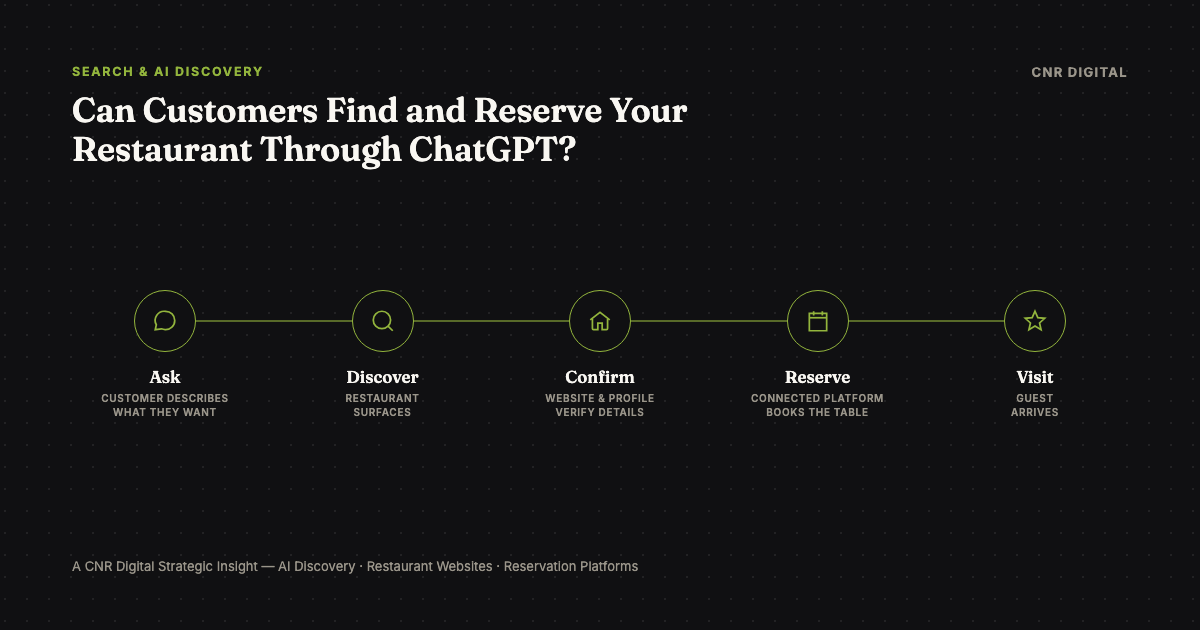
A customer opens ChatGPT and asks for a good Italian restaurant nearby with outdoor seating for Saturday night. Increasingly, that conversation can end with an actual reservation, not just a suggestion.
That's a meaningful shift for restaurant owners, and it raises a fair question: can ChatGPT actually find your restaurant, and can someone book a table there without ever visiting your website?
Can ChatGPT recommend restaurants? Yes. ChatGPT can surface restaurant suggestions based on cuisine, location, price and other preferences a diner describes in conversation.
Can ChatGPT find restaurant reservations? Often, yes, but through a connected platform, not on its own. As of August 2026, OpenAI has partnered with OpenTable, Resy and Yelp so that ChatGPT users in the U.S. (and, depending on the provider, Canada or globally) can check availability and complete a booking or join a waitlist without leaving the conversation, according to Yelp's official announcement. The user describes what they want, ChatGPT collects the party size, date, time and any special requests, and the booking is completed through the connected reservation platform.
That last part matters. ChatGPT isn't a reservation system of its own. It's an interface sitting on top of the same platforms your restaurant already relies on. If your restaurant isn't set up correctly on OpenTable, Resy or Yelp, or isn't accurately represented on the web at all, there's nothing for ChatGPT to find or book.
That's the real takeaway for restaurant owners: conversational AI is a new discovery surface, not a new reservation system to separately manage. The fundamentals (an accurate website, an accurate Google Business Profile, real reviews, correctly connected reservation platforms) are what AI systems like ChatGPT actually draw from.
Restaurant owners cannot guarantee that ChatGPT or another AI system will recommend their restaurant. What they can do is improve the quality, accessibility, consistency and authority of the information available about the restaurant, across their website, Google Business Profile, reviews, reservation platforms, ordering platforms, credible third-party mentions and local search surfaces, so the restaurant is easy for both people and machines to understand.
Can ChatGPT Find Restaurants and Reservation Availability?
Yes, and increasingly it can help complete the booking too, but it's worth separating three distinct things that are easy to blur together: discovery, availability information and actual reservation completion.
Discovery is ChatGPT surfacing your restaurant as a relevant answer to what someone asked for: a cuisine, a neighborhood, an occasion, a price range.
Availability information is ChatGPT (through a connected provider) showing what times are actually open for a given date and party size.
Reservation completion is the booking itself actually going through: collected details, confirmed, and reflected on the platform your restaurant manages.
A restaurant can be discoverable without having connected availability. It can show availability without every detail about the restaurant being accurate. Don't assume that because a customer can reach your restaurant through ChatGPT, the entire experience end-to-end will be seamless. It still depends on how well-connected and accurate your underlying platforms are.
How Does Conversational AI Change Restaurant Discovery?
Traditional search still largely works on keywords. Conversational AI lets a customer describe what they actually want in a single sentence (cuisine, neighborhood, atmosphere, price, dietary needs, date and time, party size, occasion, and reservation availability) and get a shortlist of restaurants that fit, sometimes with a next step already available.
That's a real change in how people search. A customer might type something like "somewhere quiet near Journal Square for a birthday dinner, moderate price, open table for 6 on Friday at 7," a single query that used to require checking a map, a review site, and a reservation platform separately.
For restaurants, that means the underlying information (cuisine, neighborhood, atmosphere, price signals, dietary accommodations, hours and reservation availability) needs to actually be accurate and findable in the first place. Conversational AI doesn't invent this information; it retrieves and summarizes it from somewhere.
Where Does AI Get Information About Your Restaurant?
How does ChatGPT know which restaurants exist? Through a mix of sources, not one single database. AI systems generally draw on a combination of first-party websites, search engine and local business information, reservation platforms, reviews, and other public web sources and third-party coverage.
There isn't a fixed, published ranking formula that determines which restaurant gets recommended first, and CNR Digital isn't going to claim otherwise. What's more useful to understand is that these systems are pulling from the same raw material search engines already index, which is exactly why the fundamentals (an accurate website, an accurate Business Profile, real reviews, correctly connected platforms) still do the actual work.
Does Your Restaurant Website Still Matter?
Yes.
Does a restaurant website matter for AI search? It does, because your website remains the one source of information about your restaurant that you fully control. AI systems and reservation platforms can summarize and relay information, but they're generally drawing from, or checking against, what's actually published about your restaurant, and your website is where that information should be most complete and most current.
Your website is where a customer (or a system acting on a customer's behalf) can still find the full picture: your menu, location, hours, cuisine, reservation and ordering paths, private dining and events, pricing context, contact information and brand positioning. A conversational answer might summarize a few of those details, but it can't replace having a complete, accurate, easy-to-parse source behind it.
Do Reviews, Menus, Hours and Reservation Platforms Matter?
Yes, because consistency is what makes information trustworthy to retrieve and repeat.
Do Google reviews affect AI discovery? Reviews contribute to how a restaurant is understood and described, but CNR Digital won't claim they directly control what any AI system recommends. What's more accurate is that reviews are one more signal contributing to the overall picture of a restaurant (its quality, its atmosphere, what it's known for), and inconsistent or outdated review-adjacent information (like an old menu or wrong hours sitting next to current reviews) creates the same kind of confusion for AI systems that it does for a human reading them.
Does menu information matter? Yes. A current, accurate, clearly structured menu helps answer cuisine and dietary questions that customers are increasingly asking conversationally: "somewhere with a good gluten-free option" or "a vegan-friendly Italian spot" depend on that information actually being published somewhere findable.
Should restaurant websites publish pricing? General price positioning (not necessarily a full itemized menu with prices, if that's not your preference) helps both customers and AI systems answer "moderate price" or "special-occasion spot" style questions accurately, rather than leaving that to guesswork.
Should website hours match Google Business Profile? Yes. Mismatched hours between your website and your Business Profile are a common, avoidable source of exactly the kind of conflicting information that erodes trust in any system trying to represent your restaurant accurately, AI included.
Can Restaurants Optimize Specifically for ChatGPT?
There is no guaranteed method for making ChatGPT recommend a restaurant, and any claim otherwise should be treated skeptically.
Can a restaurant guarantee a ChatGPT recommendation? No, and CNR Digital won't tell you otherwise. What restaurants can do is improve their digital footprint so AI systems have better information to retrieve and understand: an accurate, crawlable website; a well-maintained Google Business Profile; correctly connected reservation and ordering platforms; and a base of legitimate customer reviews.
Is AI search replacing Google Maps? Not based on what's confirmed today. It's more accurate to describe conversational AI as an additional discovery surface alongside Google Search, Google Maps and reservation or review platforms, not a replacement for them. A restaurant still benefits from being strong across all of them, since they're often drawing from overlapping sources.
There's no shortcut that substitutes for a restaurant's actual digital foundation being accurate and complete.
What Should Restaurant Owners Do Now?
A practical starting checklist:
- Maintain a crawlable first-party website.
- Keep menu and hours current.
- Make cuisine and restaurant positioning clear.
- Keep Google Business Profile accurate.
- Maintain consistent address and contact information across every platform.
- Connect reservation and ordering platforms correctly.
- Build legitimate customer reviews.
- Earn relevant local and third-party mentions.
- Publish clear private dining, catering or event information if relevant.
- Monitor how the business appears across Google, Maps and AI assistants.
How should a new restaurant prepare for AI-driven discovery? The same way it should prepare for any other kind of discovery: with a real, digital foundation for new restaurant openings in place before or around opening day, an accurate website, a properly set up Business Profile, connected reservation platforms, and a plan for earning genuine reviews. AI discovery isn't a separate project; it's one more reason the fundamentals need to be right from the start.
Restaurants that are still working through the basics of a strong website may want to start with what a restaurant website in New Jersey actually needs to turn searches into reservations, since that same foundation is what conversational AI and reservation platforms end up drawing from. Restaurants that use Google Maps for discovery and ordering should also see how Ask Maps now handles AI-assisted ordering, a closely related shift happening on a different platform. And restaurants approaching or just past opening day can work through the first 90 days digital launch checklist to make sure the underlying information AI systems and customers both rely on is in place from day one.
It's also worth understanding what happens when that information is wrong. If an AI system is already showing inaccurate details about your restaurant, see what to do when Google AI shows incorrect business information. The correction process is similar across AI systems: document it, fix what you control, and report the rest.
Sources
- Yelp: Yelp Brings Reservations and Waitlist to ChatGPT (August 2026)
AI Search Is Changing Restaurant Discovery
Make Your Restaurant Easier to Discover: Wherever Customers Search
CNR Digital builds and manages the digital foundation around new and growing restaurants, including your website, search presence, reviews, customer capture and ongoing digital growth.
Get My Free Website ConceptPrefer to talk through your digital presence first? Start a conversation with CNR Digital.
Continue Reading
Related Insights
Restaurant Growth
Restaurant Website Design in New Jersey: What Your Website Needs to Turn Searches Into Reservations
A restaurant website should do more than show your menu. Learn what New Jersey restaurants need to turn local searches into reservations, visits and repeat customers.
Restaurant Growth
Google Maps Can Now Help Order Food With AI. Here's What Restaurant Owners Should Do.
Google's Ask Maps can now help customers find a restaurant and order food through AI conversation. Here's what actually changed, what's confirmed and what restaurant owners should do next.
Restaurant Growth
Opening a Restaurant in New Jersey or New York? Your First 90 Days Digital Launch Checklist
Opening day is only the beginning. Use this 90-day digital launch checklist to build your restaurant website, local search presence, reviews, reservations and customer relationships from the start.